
INTRODUCTION
1-Bromohexane is an organic liquid belonging to the category of alkyl bromides or bromoalkanes. Its reactivity is due to presence of bromine in the allylic position. Apart from being a useful solvent in organic synthesis, it is used in synthesis of various intermediates.
Manufacture
It is manufactured from hexene by using HBr. The process involves addition for bromine free radical across the pi bond in the substrate alkene.
| Synonyms | n-Hexyl bromide Hexyl bromide |
| CAS no. | 113-25-1 |
| EINECS no. | 203-850-2 |
| Molecular formula | C6H13Br |
| Molecular weight | 165.07 |
| Structure | 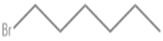 |
Applications
| Intermediates |
|---|
| It is used in manufacture of intermediates such as: * 3-(Hexylamino)phenol * 1-Fluorohexane * 2-(2-Hexyloxyethoxy)ethanol * Trihexylphosphine * N-Hexyltrimethylammonium bromide * 1-(4-Bromophenyl)hexane * 3-Hexylthiophene * 3-(Hexyloxy)benzaldehyde |
| Others |
|---|
| As alkylation agent in Grignard synthesis |
| In synthesis of bromocyclics and cyclic compounds substituted with linear C6 chain |
| In synthesis of ionic liquids for polyketones |
SPECIFICATIONS
| Test | Unit | Specification |
|---|---|---|
| Appearance | – | Colourless to pale yellow liquid |
| Identification by GC | – | Retention time of the major peak obtained from the test solution should match with that obtained from the standard solution |
| Water by KF | % | Max 0.1 |
| Acidity as HBr | % | Max 0.1 |
| Purity by GC | % | Min 98.0 |
STORAGE
Stored at ambient temperature
PACKING
250 kg UN-approved drum
REACH Status
Not registered yet
ExSyn offers 1-bromohexane on commercial scales and welcomes enquiries. No matter the quantity you need, our exceptional quality and service will make ExSyn your supplier of choice! If you need any additional information or SDS, please contact us.
p-tert-Butylphenol (PTBP), is an aromatic organic compound consists of a phenol ring substituted with a tert-butyl group at the para (4-) position, giving it improved thermal stability and hydrophobic properties compared to phenol. PTBP features significant hydrogen bonding capabilities, which enhance its solubility in organic solvents. PTBP is used primarily as an intermediate in the manufacturing of polycarbonate plastics, phenolic resins, and epoxy resins.
Yttrium oxide (Y2O3), also known as yttria, is an air-stable, odorless white powder. It is a highly stable, chemically inert ceramic with a very high melting point. It is insoluble in water but readily dissolves in most strong acids. Increasing the specific surface area and porosity of Y2O3 can further improve its relevant physical and chemical properties.
Ethyl 7,7,7-trifluoro-3-hydroxy-3-methylheptanoate is a fluorinated aliphatic hydroxy ester. The presence of the trifluoromethyl group imparts enhanced metabolic stability, lipophilicity, and unique physicochemical properties compared with non-fluorinated analogues. This compound is primarily used as a synthetic intermediate in pharmaceutical and agrochemical research.
2-Chloro-1,1,1-trimethoxyethane is an organochlorine orthoester compound commonly used as a versatile synthetic intermediate in organic and pharmaceutical chemistry. It is a colorless to pale yellow liquid with good reactivity toward nucleophilic substitution and cyclization reactions, making it valuable in the preparation of heterocyclic and bioactive molecules.
Glycolaldehyde dimer is the cyclic dimeric form of glycolaldehyde, the simplest hydroxyaldehyde. Glycolaldehyde is often supplied as stable dimeric solid, commonly identified as 2,5-dihydroxy-1,4-dioxane.
N,N-Diisopropylethylamine (DIPEA), also known as Hünig’s Base, is a sterically hindered tertiary amine. It is a colorless liquid with a strong amine odor and is widely used as a low nucleophilic organic base in pharmaceutical, agrochemical, and fine chemical synthesis. Due to its bulky structure, DIPEA effectively scavenges acids without participating in unwanted side reactions.
Tris(2,4-di-tert-butylphenyl) phosphite (TDPP) often recognized commercially as Irgafos 168 is a high-performance organophosphorus compound primarily utilized as secondary antioxidant and processing stabilizer. Its characteristic to undergo metallation reaction and provide a cost-effective synthetic processes allows it to be useful in biaryl coupling reactions.
Undecylenic acid is an unsaturated fatty acid naturally derived from castor oil. It is a colorless to pale yellow liquid with antifungal and antimicrobial properties. Chemically known as 10-undecenoic acid, it contains an 11-carbon chain with one double bond and is widely used in pharmaceuticals
5-Nitro Isophthalic Acid (5-NIPA) is an aromatic organic compound derived from isophthalic acid. The presence of two carboxylic acid groups along with a nitro substituent at the 5-position makes it a valuable intermediate in the manufacture of fine chemicals, pharmaceuticals, dyes, pigments, and advanced materials.