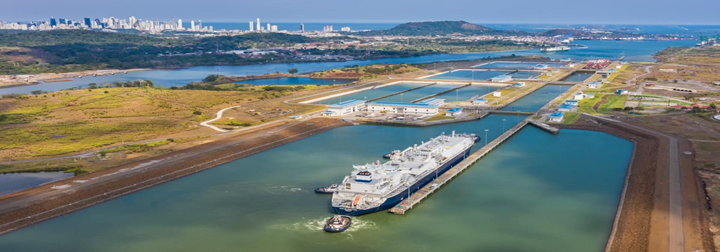
The severe drought which has forced the Panama Canal, one of the world’s busiest trade passages, to limit daily crossings could impact global supply chains during a period of high demand.
The canal has imposed several restrictions since 2023, though last month the Panama Canal Authority bumped up daily crossings to 27, from 24, as water levels rose at the man-made Gatun Lake which feeds into the canal.
“Capacity pressures at the Panama Canal are starting to have an effect on supply chains,” S&P Global said in an analyst report on transportation of cargo and raw materials. “Container ships have yet to feel the impact in light of their priority status, although the situation is changing.”
Container ships have priority to pass through the Panama Canal, but transit restrictions have hurt other categories, particularly bulk carriers.
If rains return in May as expected, the canal authority plans to ramp daily slots back up to about 36 per day, the average during rainy season.
The need to maintain water levels at the reservoirs feeding into the canal has prevented it from absorbing demand from shippers seeking alternative routes away from the Red Sea, where Houthi attackers have blocked the passage of ships in the Suez Canal, the world’s busiest waterway.
Reference:
Today we announce that Exim is rebranding as ExSyn. We are presenting a new brand identity and website as a reflection of our relentless transformation over the course of 30 years serving the pharma and chemical industries. The new brand builds upon our core strengths as a sourcing company and captures our most essential duty: helping improve people’s health and lives.
A significant uptick in M&A activity in the biosimilars sector is being driven by FDA regulatory reforms, a maturing patent litigation framework and a looming patent cliff — $200 billion of branded products are facing patent expiration by 2030.
The Drewry World Container Index edged lower this week as falling Asia-Europe rates outweighed firmer pricing on the Transpacific, with carriers preparing another round of blank sailings ahead of China’s Golden Week holiday.
Diacetone Alcohol (DAA) is an aliphatic hydroxy ketone produced through the base-catalysed aldol addition of two acetone molecules. It contains both ketone and tertiary hydroxyl functionalities, offering excellent solvency and chemical reactivity.
As a high-boiling oxygenated solvent and valuable chemical intermediate, DAA finds broad application in paints and coatings, printing inks, adhesives, industrial cleaning, cosmetics, and textiles. It is also used as an intermediate in the production of mesityl oxide and MIBK. (4-methylpentan-2-one).