INTRODUCTION
Undecylenic acid is an unsaturated fatty acid naturally derived from castor oil. It is a colorless to pale yellow liquid with antifungal and antimicrobial properties. Chemically known as 10-undecenoic acid, it contains an 11-carbon chain with one double bond and is widely used in pharmaceuticals, cosmetics, personal care products, and chemical intermediates. It is especially effective against fungal infections of the skin and nails.
MANUFACTURE
It is mainly manufactured from castor oil through the following process:
1.Castor oil is hydrolyzed to obtain ricinoleic acid.
2.Ricinoleic acid undergoes pyrolysis (thermal cracking) to produce undecylenic acid and heptaldehyde as a by-product.
3.The crude product is purified by distillation to obtain high-purity undecylenic acid.
| Synonym(s) | 10-Undecenoic Acid; 10-Henedecenoic Acid; Declid; Desenex; 9-Undecylenic acid |
| CAS no. | 112-38-9 |
| EINECS no. | 203-965-8 |
| Molecular formula | C11H20O2 |
| Molecular weight | 184.28 |
| Structure | 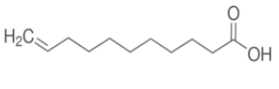 |
APPLICATIONS
| Used as an antifungal agent in creams, ointments, powders, and sprays for treating athlete’s foot, ringworm, and other fungal infections. |
| Used in the manufacture of undecylenate salts and esters for pharmaceutical and cosmetic applications. |
| Acts as an intermediate in perfumes, lubricants, resins, and specialty polymers. |
| Used in personal care products such as deodorants, soaps, and shampoos due to its antimicrobial activity. |
| Utilized in chemical synthesis for plasticizers, surfactants, and specialty chemicals. |
SPECIFICATIONS (USP & In-house)
| Test | Unit | Specification |
|---|---|---|
| Appearance | – | Clear, colorless to pale yellow liquid having a characteristic odor |
| Solubility | – | Practically insoluble in water, Miscible with alcohol, with Chloroform, with Ether, with Benzene & fixed & volatile oils |
| Identification | ||
| A. Spectroscopic identification test-IR spectroscopy | – | The infrared spectrum of sample preparation should exhibit maxima only at the same wavelengths as that of a similar preparation of working standard |
| B. The retention time of the undecylenic acid peak of the sample solution corresponds to that of the standard solution, as obtained in assay | – | Retention time should comply |
| Residue on Ignition | % | NMT 0.15 |
| Water soluble acids | % | NMT 1.0 ml of 0.01N Sodium Hydroxide require for test |
| Specific gravity (at 25ºC) | – | 0.910 – 0.913 |
| Iodine value | gI2/100g | 131 – 138 |
| Assay (by GC) | % | 97.0 – 102.0 |
| Residual solvent | ||
| Methanol | ppm | NMT 3000 |
| Microbiological analysis | ||
| Total microbial count | cfu/gm | Max 100 |
| Escherichia coli | – | Should be absent |
| Salmonella spp | – | Should be absent |
| Pseudomonas aeruginosa | – | Should be absent |
| Staphylococcus aureus | – | Should be absent |
PACKING
25 kg UN approved carboy
STORAGE
Store product in its original container. Keep container tightly closed in a dry and well-ventilated place. Containers which are opened must be carefully resealed and kept upright to prevent leakage.
REACH status
Not registered
ExSyn offers Undecylenic acid on commercial scales and welcomes enquiries. Our exceptional quality and service will make ExSyn your supplier of choice! If you need additional information or SDS, please contact us.
Today we announce that Exim is rebranding as ExSyn. We are presenting a new brand identity and website as a reflection of our relentless transformation over the course of 30 years serving the pharma and chemical industries. The new brand builds upon our core strengths as a sourcing company and captures our most essential duty: helping improve people’s health and lives.
A significant uptick in M&A activity in the biosimilars sector is being driven by FDA regulatory reforms, a maturing patent litigation framework and a looming patent cliff — $200 billion of branded products are facing patent expiration by 2030.
The Drewry World Container Index edged lower this week as falling Asia-Europe rates outweighed firmer pricing on the Transpacific, with carriers preparing another round of blank sailings ahead of China’s Golden Week holiday.
Diacetone Alcohol (DAA) is an aliphatic hydroxy ketone produced through the base-catalysed aldol addition of two acetone molecules. It contains both ketone and tertiary hydroxyl functionalities, offering excellent solvency and chemical reactivity.
As a high-boiling oxygenated solvent and valuable chemical intermediate, DAA finds broad application in paints and coatings, printing inks, adhesives, industrial cleaning, cosmetics, and textiles. It is also used as an intermediate in the production of mesityl oxide and MIBK. (4-methylpentan-2-one).