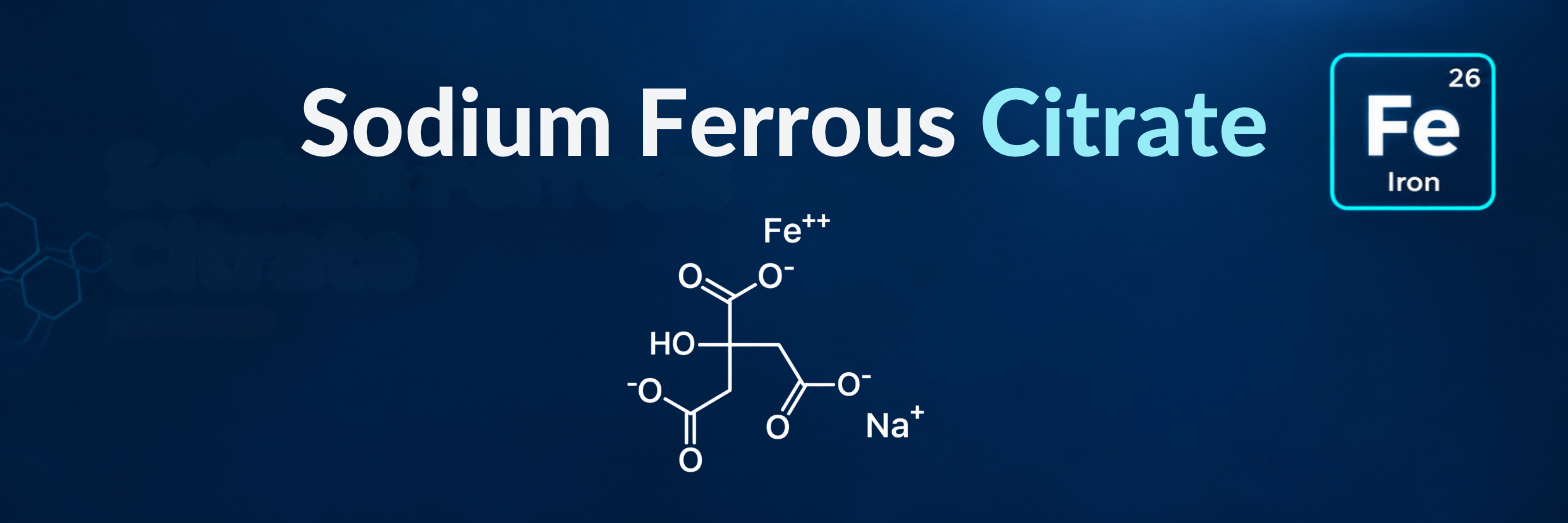
INTRODUCTION
Sodium ferrous citrate is an iron-containing compound used as a source of iron in pharmaceutical and nutritional formulations. It helps prevent and treat iron deficiency and iron-deficiency anemia by providing bioavailable iron for hemoglobin formation and red blood cell production. It is used in iron supplements and selected pharmaceutical preparations.
MANUFACTURE
It is generally manufactured by reacting a suitable ferrous iron source, such as ferrous sulfate, with sodium citrate under controlled conditions. The resulting iron–citrate complex is processed through suitable purification, concentration, and drying steps to obtain the desired product. Manufacturing conditions are controlled to maintain iron content, purity, and product stability.
| Synonym(s) | Iron(II) sodium 2-hydroxypropane-1,2,3-tricarboxylate |
| CAS no. | 43160-25-4 |
| EINECS no. | – |
| Molecular formula | C₁₂H₁₀O₁₄Fe Na₄ |
| Molecular weight | 526.01 |
| Structure | 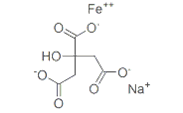 |
APPLICATIONS
Sodium ferrous citrate is an important iron compound used mainly in pharmaceutical and nutritional applications, particularly for iron supplementation and food fortification:
| Pharmaceutical industry: Used in iron supplements for the prevention and treatment of iron deficiency. |
| Nutritional supplements: Provides iron to support normal hemoglobin formation and red blood cell production. |
| Food fortification: Can be used as an iron source in food products, subject to applicable regulatory requirements. |
| Healthcare products: Used as an ingredient in formulations designed to address inadequate dietary iron intake. |
SPECIFICATIONS
| Test | Unit | Specification |
|---|---|---|
| Description | – | Odorless, green-white to greenish yellow powder |
| Solubility | – | Readily soluble in acidic solvents, practically insoluble in water & insoluble in basic solvents. |
| Identification | – | Positive for Sodium Citrate and Ferrous Iron |
| Arsenic | mg/kg | Max 4.0 |
| Lead | mg/kg | Max 1.0 |
| Ferric Iron | – | Meets test |
| Sulfate | g/kg | Max 4.8 |
| Tartrate | – | No white, crystalline precipitate is formed. |
| Assay (Iron content) | % | 10.0 – 11.0 |
PACKING
25 kg & 50 kg bag / drum
STORAGE
Store in light-resistant, well-closed container
REACH status
Not registered
ExSyn offers Sodium ferrous citrate on commercial scales and welcomes enquiries. Our exceptional quality and service will make ExSyn your supplier of choice! If you need additional information or SDS, please contact us.
Vinylbenzyl chloride, commonly referred to as CMS-P, is typically an equimolar mixture of meta and para chloromethyl styrenes. CMS-P is a bifunctional monomer, featuring both a polymerizable vinyl group and a reactive benzylic chloride functionality. It is widely used as an intermediate in synthesis of specialty polymers and can readily copolymerize with various monomers, making it valuable in the production of advanced and specialty plastics.
N,N′-Dimethylethylenediamine (DMEDA) is an organic chemical compound belonging to the diamine family. It contains two nitrogen atoms, each bearing a methyl group, connected by a two-carbon chain.
FerroQuant™ Pro is a water-soluble chromogenic reagent widely used for the spectrophotometric determination of iron. Chemically, it is a ferroin-type ligand that forms a stable, intensely colored complex with ferrous ions (Fe²⁺).
N-Vinylformamide (NVF) is a vinyl-functionalized amide and an important monomer used in the production of poly(N-vinylformamide) (PNVF). NVF is valued for its ability to undergo polymerization, producing polymers with useful water solubility, film-forming properties, and functional groups suitable for further chemical modification.
Diacetone Alcohol (DAA) is an aliphatic hydroxy ketone produced through the base-catalysed aldol addition of two acetone molecules. It contains both ketone and tertiary hydroxyl functionalities, offering excellent solvency and chemical reactivity.
As a high-boiling oxygenated solvent and valuable chemical intermediate, DAA finds broad application in paints and coatings, printing inks, adhesives, industrial cleaning, cosmetics, and textiles. It is also used as an intermediate in the production of mesityl oxide and MIBK. (4-methylpentan-2-one).
Kojic acid is a natural fungal metabolite produced through natural fermentation of carbohydrates. It works primarily as a tyrosinase inhibitor, suppressing melanin production to help reduce dark spots and even out skin tone. It also delivers antioxidant benefits, neutralizing free radicals and protecting skin cells from oxidative stress. With its naturally weak acidic profile, kojic acid is a multifunctional ingredient suited for brightening and protective skincare formulations.
(S)-Oxetan-2-yl-methanamine is a chiral oxetane-containing primary amine. The compound features a strained four-membered oxetane ring and an aminomethyl substituent, making it a valuable building block in modern medicinal chemistry. Due to its unique physicochemical properties, including increased polarity and metabolic stability compared with conventional alkyl groups, it is widely employed as an advanced pharmaceutical intermediate in drug discovery and development programs.
Guanidine carbonate is a white, crystalline, water-soluble compound with an alkaline and ionic nature. Composed of guanidinium cations and carbonate anions, it offers chemical stability, buffering capacity, and good formulation compatibility. In textile applications, it is used in formulations and fabric treatments for its thickening, softening, lubricating, anti-static, and flame-retardant properties, contributing to improved fabric finish and performance.
Tin(II) sulfide (SnS) has emerged as a safe and sustainable semiconductor owing to its non-toxicity, low cost, and natural abundance. It has attracted significant interest for solar energy conversion in thin-film photovoltaic devices because of its suitable band gap, which is approximately 1.3 eV in the orthorhombic phase and 1.5-1.7 eV in the cubic phase. In addition to photovoltaic applications, SnS is used in solid-state lubricants, near-infrared detectors, Lithium-ion batteries, and various sensing devices.