
INTRODUCTION
p–tert-Butylphenol (PTBP), is an aromatic organic compound consists of a phenol ring substituted with a tert-butyl group at the para (4-) position, giving it improved thermal stability and hydrophobic properties compared to phenol. PTBP features significant hydrogen bonding capabilities, which enhance its solubility in organic solvents. PTBP is used primarily as an intermediate in the manufacturing of polycarbonate plastics, phenolic resins, and epoxy resins.
MANUFACTURE
It is synthesized by incorporating a gaseous isobutylene or liquid tert-butanol into phenols in the presence of an acid-activated clay or sulfuric/phosphoric acid on an alumina support as a catalyst. The reaction takes place at elevated temperatures (typically between 150° C and 250° C) and moderate to high pressures. It is further purified by fractional distillation to remove unreacted phenol, ortho-isomer and multi-alkylated byproducts.
| Synonyms | 4-tert-butylphenol, 1-tert-butyl-4-hydroxybenzene, Butylphen, 1-hydroxy-4-tert-butylbenzene, |
| CAS no. | 98-54-4 |
| EINECS no. | 202-679-0 |
| Molecular formula | C10H14O |
| Molecular weight | 150.22 |
| Structure | 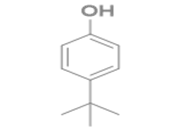 |
APPLICATIONS
The chemical properties of PTBP make it a versatile substance in various industrial applications.
| Polymer and resin industries: |
| • It functions as a key monomer and chain-terminator in the polymer industry, regulating molecular weight and providing excellent thermal and UV stability |
| Adhesive and coating: |
| • Its phenolic structure contributes to improved adhesion, making it an essential ingredient in formulating high-performing adhesives. |
| • PTBP’s ability to enhance the thermal and chemical resistance of adhesives allows for greater durability in a variety of applications, including automotive, construction, and electronics. |
| • It helps to improve the gloss, hardness, and resistance to moisture and chemicals, which are vital for protective coatings. |
| Pharmaceutical industry: |
| • Primarily used as an intermediate for the manufacturing of APIs, as a polymerization regulator for drug delivery coatings and as a stabilizing antioxidant in formulations to prevent degradation of sensitive active ingredients. |
| • It also has usage as a diagnostic agent. |
| Used as a raw material intermediate to synthesize perfumery ingredients like para-tert-butyl cyclohexyl acetate (PTBCHA). |
SPECIFICATIONS
| Test | Unit | Specification |
|---|---|---|
| Appearance | – | White flakes |
| Purity | % | Min 99 |
| Melting Point | °C | Min 97 |
| Moisture | % | Max 0.3 |
| APHA | – | Max 50 |
STORAGE & PRECAUTION
Storage temperature ≤ 35 ˚C. Store in a tightly sealed container away from direct sunlight.
PACKING
25 Kg UN approved paper bag.
REACH STATUS
Registered
ExSyn offers p-tert-butylphenol on commercial scales and welcomes enquiries. No matter the quantity you need, our exceptional quality and service will make ExSyn your supplier of choice! If you need any additional information or SDS, please contact us.
Today we announce that Exim is rebranding as ExSyn. We are presenting a new brand identity and website as a reflection of our relentless transformation over the course of 30 years serving the pharma and chemical industries. The new brand builds upon our core strengths as a sourcing company and captures our most essential duty: helping improve people’s health and lives.
A significant uptick in M&A activity in the biosimilars sector is being driven by FDA regulatory reforms, a maturing patent litigation framework and a looming patent cliff — $200 billion of branded products are facing patent expiration by 2030.
The Drewry World Container Index edged lower this week as falling Asia-Europe rates outweighed firmer pricing on the Transpacific, with carriers preparing another round of blank sailings ahead of China’s Golden Week holiday.
Diacetone Alcohol (DAA) is an aliphatic hydroxy ketone produced through the base-catalysed aldol addition of two acetone molecules. It contains both ketone and tertiary hydroxyl functionalities, offering excellent solvency and chemical reactivity.
As a high-boiling oxygenated solvent and valuable chemical intermediate, DAA finds broad application in paints and coatings, printing inks, adhesives, industrial cleaning, cosmetics, and textiles. It is also used as an intermediate in the production of mesityl oxide and MIBK. (4-methylpentan-2-one).