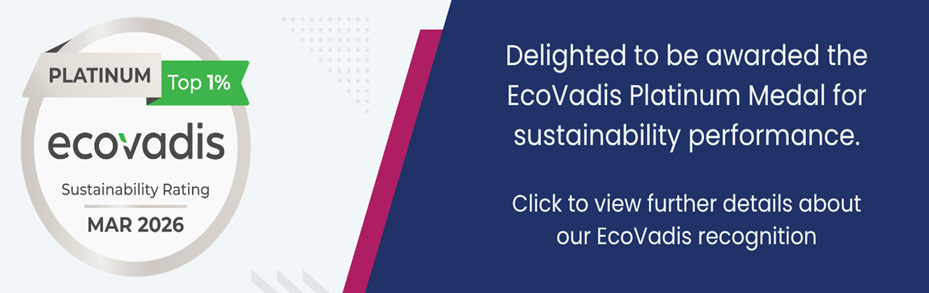
We’re pleased to share an important milestone in our sustainability journey.
ExSyn has been awarded the EcoVadis Platinum Medal, placing us among the top 1% of companies globally evaluated for environmental, social and ethical performance.
This recognition, achieved in our first assessment, reflects our strong focus on responsible business practices.
From strengthening compliance frameworks to advancing sustainable procurement and operations, we remain committed to building a transparent and sustainable value chain.
We thank our customers, suppliers and partners for their continued trust and support.
Warm regards,
The ExSyn Team
Today we announce that Exim is rebranding as ExSyn. We are presenting a new brand identity and website as a reflection of our relentless transformation over the course of 30 years serving the pharma and chemical industries. The new brand builds upon our core strengths as a sourcing company and captures our most essential duty: helping improve people’s health and lives.
A significant uptick in M&A activity in the biosimilars sector is being driven by FDA regulatory reforms, a maturing patent litigation framework and a looming patent cliff — $200 billion of branded products are facing patent expiration by 2030.
The Drewry World Container Index edged lower this week as falling Asia-Europe rates outweighed firmer pricing on the Transpacific, with carriers preparing another round of blank sailings ahead of China’s Golden Week holiday.
Diacetone Alcohol (DAA) is an aliphatic hydroxy ketone produced through the base-catalysed aldol addition of two acetone molecules. It contains both ketone and tertiary hydroxyl functionalities, offering excellent solvency and chemical reactivity.
As a high-boiling oxygenated solvent and valuable chemical intermediate, DAA finds broad application in paints and coatings, printing inks, adhesives, industrial cleaning, cosmetics, and textiles. It is also used as an intermediate in the production of mesityl oxide and MIBK. (4-methylpentan-2-one).