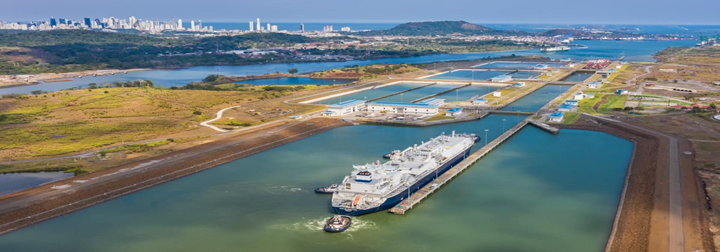
The severe drought which has forced the Panama Canal, one of the world’s busiest trade passages, to limit daily crossings could impact global supply chains during a period of high demand.
The canal has imposed several restrictions since 2023, though last month the Panama Canal Authority bumped up daily crossings to 27, from 24, as water levels rose at the man-made Gatun Lake which feeds into the canal.
“Capacity pressures at the Panama Canal are starting to have an effect on supply chains,” S&P Global said in an analyst report on transportation of cargo and raw materials. “Container ships have yet to feel the impact in light of their priority status, although the situation is changing.”
Container ships have priority to pass through the Panama Canal, but transit restrictions have hurt other categories, particularly bulk carriers.
If rains return in May as expected, the canal authority plans to ramp daily slots back up to about 36 per day, the average during rainy season.
The need to maintain water levels at the reservoirs feeding into the canal has prevented it from absorbing demand from shippers seeking alternative routes away from the Red Sea, where Houthi attackers have blocked the passage of ships in the Suez Canal, the world’s busiest waterway.
Reference:
Today we announce that Exim is rebranding as ExSyn. We are presenting a new brand identity and website as a reflection of our relentless transformation over the course of 30 years serving the pharma and chemical industries. The new brand builds upon our core strengths as a sourcing company and captures our most essential duty: helping improve people’s health and lives.
While fears around a complete shutdown of the Strait of Hormuz primarily raise concerns around oil prices and energy security, recent history shows that even partial disruptions or security threats along key sea routes can quickly spill over into freight inflation, longer transit times and working capital stress for exporters and importers.
1,4,7-Trimethyl-1,4,7-triazonane (Me₃TACN) is a valuable macrocyclic tridentate ligand derived from 1,4,7-triazacyclononane. In Me₃TACN, each nitrogen atom is substituted with a methyl group, which significantly modifies its steric and electronic properties. Me₃TACN is widely used as a ligand in coordination chemistry due to its ability to form stable complexes with transition metals such as Cu, Ni, Fe, Mn, and Zn.
Adenosine is a naturally occurring purine nucleoside composed of adenine and ribose, present in all living cells. It plays a vital role in biochemical processes such as energy transfer (ATP/ADP), signal transduction, and regulation of physiological functions, and is widely used in pharmaceutical applications.