
Introduction
Vinylbenzyl chloride, commonly referred to as CMS-P, is typically an equimolar mixture of meta and para chloromethyl styrenes. CMS-P is a bifunctional monomer, featuring both a polymerizable vinyl group and a reactive benzylic chloride functionality. It is widely used as an intermediate in synthesis of specialty polymers and can readily copolymerize with various monomers, making it valuable in the production of advanced and specialty plastics.
Manufacture
CMS-P can be synthesized by converting a mixture of the corresponding vinylbenzyl alcohols to their chlorides (–CH₂OH → –CH₂Cl) using classical chlorinating agents such as thionyl chloride, phosphorus chlorides, or related halogenating reagents. Alternative synthetic routes include chloromethylation of vinyl benzene, or halogenation of alkyl side chains followed by controlled dehydrohalogenation.
| Synonyms | Chloromethylstyrene (mixed isomers), ar-Vinylbenzyl chloride and (Chloromethyl)ethenylbenzene |
| CAS no. | 30030-25-2 |
| EINECS no. | 250-005-9 |
| Molecular formula | C₉H₉Cl |
| Molecular weight | 152.62 |
| Structure | 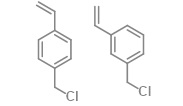 |
Applications
CMS-P is a key monomer and versatile intermediate in organic chemistry. The main areas of application include:
| Specialty Polymer Synthesis: |
| Used as a functional monomer to introduce chloromethyl groups into polymer chains. |
| Important for grafting, crosslinking, and post-polymer functionalization. |
| Electronic & Semiconductor Materials: |
| Useful in preparing dielectric polymers and functional coatings for electronic components. |
| Ion-Exchange Resin Manufacturing: |
| CMS-P serves as a precursor for quaternary ammonium functional resins used in water treatment, pharmaceutical purification, catalytic systems, etc. |
| Reactive Intermediate for Chemical Modifications: |
| Chloromethyl group allows easy substitution with amines, thiols and various nucleophiles enables creation of customized polymers with specific functional groups. |
| Coatings & Adhesives: |
| Widely used in specialty high-performance coatings for applications requiring superior weather resistance, UV stability, and chemical resistance. |
| Biomedical & Diagnostic Applications: |
| Functional CMS-polymers are used to prepare i) Affinity chromatography media, ii) Diagnostic assay materials and iii) Bio-functional surfaces (after amination or PEGylation). |
SPECIFICATIONS
| Test | Unit | Specification |
|---|---|---|
| Appearance | – | Colorless to light yellow color liquid |
| Purity (By GC) | % Area | ≥ 98.0 |
| Isomer ratio | % Area | m-CMS: 46.0-52.0 p-CMS: 46.0-52.0 o-CMS: ≤0.5 |
| Single maximum unknown impurity | % Area | ≤ 0.5 |
| Total Impurities | % Area | ≤ 2.0 |
| TBC (stabilizer) | ppm | ≤ 500 |
STORAGE & PRECAUTION
Store in dark at 2-8 °C in a tightly closed container
PACKING
Globally compliant packaging
REACH Status
Not registered
ExSyn offers CMS-P (Chloromethylstyrene (mixed isomers)) on commercial scales and welcomes enquiries. No matter the quantity you need, our exceptional quality and service will make ExSyn your supplier of choice! If you need any additional information or SDS, please contact us.
N,N′-Dimethylethylenediamine (DMEDA) is an organic chemical compound belonging to the diamine family. It contains two nitrogen atoms, each bearing a methyl group, connected by a two-carbon chain.
FerroQuant™ Pro is a water-soluble chromogenic reagent widely used for the spectrophotometric determination of iron. Chemically, it is a ferroin-type ligand that forms a stable, intensely colored complex with ferrous ions (Fe²⁺).
N-Vinylformamide (NVF) is a vinyl-functionalized amide and an important monomer used in the production of poly(N-vinylformamide) (PNVF). NVF is valued for its ability to undergo polymerization, producing polymers with useful water solubility, film-forming properties, and functional groups suitable for further chemical modification.
Diacetone Alcohol (DAA) is an aliphatic hydroxy ketone produced through the base-catalysed aldol addition of two acetone molecules. It contains both ketone and tertiary hydroxyl functionalities, offering excellent solvency and chemical reactivity.
As a high-boiling oxygenated solvent and valuable chemical intermediate, DAA finds broad application in paints and coatings, printing inks, adhesives, industrial cleaning, cosmetics, and textiles. It is also used as an intermediate in the production of mesityl oxide and MIBK. (4-methylpentan-2-one).
Kojic acid is a natural fungal metabolite produced through natural fermentation of carbohydrates. It works primarily as a tyrosinase inhibitor, suppressing melanin production to help reduce dark spots and even out skin tone. It also delivers antioxidant benefits, neutralizing free radicals and protecting skin cells from oxidative stress. With its naturally weak acidic profile, kojic acid is a multifunctional ingredient suited for brightening and protective skincare formulations.
(S)-Oxetan-2-yl-methanamine is a chiral oxetane-containing primary amine. The compound features a strained four-membered oxetane ring and an aminomethyl substituent, making it a valuable building block in modern medicinal chemistry. Due to its unique physicochemical properties, including increased polarity and metabolic stability compared with conventional alkyl groups, it is widely employed as an advanced pharmaceutical intermediate in drug discovery and development programs.
Guanidine carbonate is a white, crystalline, water-soluble compound with an alkaline and ionic nature. Composed of guanidinium cations and carbonate anions, it offers chemical stability, buffering capacity, and good formulation compatibility. In textile applications, it is used in formulations and fabric treatments for its thickening, softening, lubricating, anti-static, and flame-retardant properties, contributing to improved fabric finish and performance.
Tin(II) sulfide (SnS) has emerged as a safe and sustainable semiconductor owing to its non-toxicity, low cost, and natural abundance. It has attracted significant interest for solar energy conversion in thin-film photovoltaic devices because of its suitable band gap, which is approximately 1.3 eV in the orthorhombic phase and 1.5-1.7 eV in the cubic phase. In addition to photovoltaic applications, SnS is used in solid-state lubricants, near-infrared detectors, Lithium-ion batteries, and various sensing devices.
Nikethamide is a synthetic organic compound derived from nicotinic acid (vitamin B₃). It consists of a pyridine ring linked to a diethyl amide functional group and belongs to the class of pyridine amide derivatives.