INTRODUCTION
Nikethamide is a synthetic organic compound derived from nicotinic acid (vitamin B₃). It consists of a pyridine ring linked to a diethyl amide functional group and belongs to the class of pyridine amide derivatives. Historically, it has been used as a central nervous system (CNS) and respiratory stimulant, acting to enhance ventilation and assist in the correction of respiratory depression. Nikethamide is typically supplied as a liquid substance, most commonly formulated as aqueous injection solutions (e.g., ~25% w/v) and, less commonly, in oral liquid or lozenge forms.
Manufacture
Nikethamide is manufactured by converting nicotinic acid into an activated intermediate, then reacting it with diethylamine to form the amide, followed by purification to meet BP standards.
| Synonyms | N,N-diethyl-3-pyridinecarboxamide; Nicethamide; |
| CAS no. | 59-26-7 |
| EINECS no. | 200-418-5 |
| Molecular Formula | C10H14N2O |
| Molecular Weight | 178.23 |
| Structure | 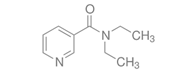 |
Applications
Nikethamide BP is a pharmacopoeial-grade CNS and respiratory stimulant. Its applications are mostly medical with some niche veterinary and emergency uses.
| Pharmaceutical /Medicinal Use |
| ➢ In treatment of acute respiratory depression by stimulating the medullary respiratory center, increasing breathing rate and depth. |
| ➢ Used alongside antidotes to restore breathing and consciousness. |
| ➢ Provides mild cardiovascular stimulation by increasing heart rate and blood pressure. |
| Niche Applications |
| ➢ Used to improve alertness and endurance in extreme conditions. |
| Research / Pharmacology Studies |
| ➢ Used to study respiratory control mechanisms and CNS stimulants |
| Veterinary Applications |
| ➢ Recovery from anaesthesia or sedation. |
| ➢ As a neonatal revival agent it helps initiate breathing in newborn animals. |
SPECIFICATIONS – BP
| Test | Unit | Specification |
|---|---|---|
| Appearance | – | Colourless or slightly yellowish oily liquid/ crystalline mass with faint characteristic odor |
| Solubility | – | Miscible with Water, Ethanol (96%), Chloroform and Ether |
| Identification (Second identification A,C,D) | ||
| A. By Spectrophotometry | – | Should meet as per BP monograph |
| C. Reaction with Sodium Hydroxide | – | Should meet as per BP monograph |
| D. Reaction with Cyanogen bromide | – | Should meet as per BP monograph |
| Appearance | – | The substance under examination in liquid form and clear by slight heating and not more intensely coloured then reference solution Ys |
| pH | – | 6.0 – 7.8 |
| Refractive Index | – | 1.524 – 1.526 |
| Sulphated Ash | % | NMT 0.1 |
| Water content (By Semi micro determination) | % | NMT 0.3 |
| Related Substances | ||
| Reference solution (a) | % | NMT 1.0 |
| Reference solution (b) | % | NMT 0.1 |
| Assay | % | 99.0 – 101.0 |
| Residual Solvents | ||
| Toluene | ppm | NMT 890 |
PACKING
25 Kgs UN approved SS Can
STORAGE
Store in a cool, well-ventilated place, out of direct sunlight
REACH status
Not registered
ExSyn offers Nikethamide BP (N,N – Diethylnicotamide) on commercial scales and welcomes enquiries. No matter the quantity you need, our exceptional quality and service will make ExSyn your supplier of choice! If you need any additional information or SDS, please contact us.
Today we announce that Exim is rebranding as ExSyn. We are presenting a new brand identity and website as a reflection of our relentless transformation over the course of 30 years serving the pharma and chemical industries. The new brand builds upon our core strengths as a sourcing company and captures our most essential duty: helping improve people’s health and lives.
A significant uptick in M&A activity in the biosimilars sector is being driven by FDA regulatory reforms, a maturing patent litigation framework and a looming patent cliff — $200 billion of branded products are facing patent expiration by 2030.
The Drewry World Container Index edged lower this week as falling Asia-Europe rates outweighed firmer pricing on the Transpacific, with carriers preparing another round of blank sailings ahead of China’s Golden Week holiday.
Diacetone Alcohol (DAA) is an aliphatic hydroxy ketone produced through the base-catalysed aldol addition of two acetone molecules. It contains both ketone and tertiary hydroxyl functionalities, offering excellent solvency and chemical reactivity.
As a high-boiling oxygenated solvent and valuable chemical intermediate, DAA finds broad application in paints and coatings, printing inks, adhesives, industrial cleaning, cosmetics, and textiles. It is also used as an intermediate in the production of mesityl oxide and MIBK. (4-methylpentan-2-one).