INTRODUCTION
Tris(2,4-di-tert-butylphenyl) phosphite (TDPP) often recognized commercially as Irgafos 168 is a high-performance organophosphorus compound primarily utilized as secondary antioxidant and processing stabilizer. Its characteristic to undergo metallation reaction and provide a cost-effective synthetic processes allows it to be useful in biaryl coupling reactions. It protects polymers which are prone to oxidation during the processing (comounding/palletizing, fabrication and recycling) from molecular weight change (by Chain scission or crosslinking) and prevents discolouration.
Manufacture
TDPP is prepared by reacting 2,4-di-tert-butylphenol with phosphorus trichloride (PCl₃) to form the phosphite ester, followed by purification to obtain Tris(2,4-di-tert-butylphenyl) phosphite.
| Synonyms | tris(2,4-di-tert-butylphenyl) phosphite |
| CAS no. | 31570-04-4 |
| EINECS no. | 250-709-6 |
| Molecular formula | C₄₂H₆₃O₃P |
| Molecular Weight | 646.9 |
| Structure | 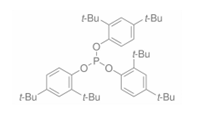 |
Applications
TDPP is primarily used as a secondary antioxidant and processing stabilizer in polymers such as polyethylene, polypropylene, PVC, and engineering plastics. Its versatility across polymer systems enables a wide range of industrial applications, including the following:
| Polymer Stabilization |
| Reliable secondary antioxidant for high-temperature polymer processing of Polypropylene (PP) Polyethylene (HDPE, LDPE, LLDPE) Engineering plastics (ABS, polycarbonate blends) |
| Polyolefin Processing |
| Used as a stabilizer in Injection molding, blow molding & extrusion processes |
| Coatings, Adhesives & Sealants |
| Used in Industrial coatings Pressure-sensitive adhesives sealant formulations |
| Rubber & Elastomers |
| Synthetic rubber processing |
| Automotive rubber parts |
| Synergistic Use with Primary Antioxidants |
| Acts as performance multiplier |
SPECIFICATIONS
| Test | Unit | Specification |
|---|---|---|
| Appearance | – | White, free flowing powder /granules |
| Melting range | °C | 183 – 186 |
| Density (20⁰C) | g/ml | 1.03 |
| Bulk density | g/l | 480 – 570 |
| Typical Properties | ||
| Solubility @ 20°C : Solvents g/100g | ||
| Cyclohexane | g/100 g | 16 |
| Dichloromethane | g/100 g | 36 |
| Toluene | g/100 g | 30 |
| Chloroform | g/100 g | 36 |
PACKING
25kg Bag
STORAGE
Store at ambient conditions in tightly closed containers and in well ventilated area
REACH status
EU REACH Registered
ExSyn offers Tris(2,4-di-tert-butylphenyl) phosphite (TDPP) on commercial scales and welcomes enquiries. No matter the quantity you need, our exceptional quality and service will make ExSyn your supplier of choice! If you need any additional information or SDS, please contact us.
Today we announce that Exim is rebranding as ExSyn. We are presenting a new brand identity and website as a reflection of our relentless transformation over the course of 30 years serving the pharma and chemical industries. The new brand builds upon our core strengths as a sourcing company and captures our most essential duty: helping improve people’s health and lives.
A significant uptick in M&A activity in the biosimilars sector is being driven by FDA regulatory reforms, a maturing patent litigation framework and a looming patent cliff — $200 billion of branded products are facing patent expiration by 2030.
The Drewry World Container Index edged lower this week as falling Asia-Europe rates outweighed firmer pricing on the Transpacific, with carriers preparing another round of blank sailings ahead of China’s Golden Week holiday.
Diacetone Alcohol (DAA) is an aliphatic hydroxy ketone produced through the base-catalysed aldol addition of two acetone molecules. It contains both ketone and tertiary hydroxyl functionalities, offering excellent solvency and chemical reactivity.
As a high-boiling oxygenated solvent and valuable chemical intermediate, DAA finds broad application in paints and coatings, printing inks, adhesives, industrial cleaning, cosmetics, and textiles. It is also used as an intermediate in the production of mesityl oxide and MIBK. (4-methylpentan-2-one).