
INTRODUCTION
Adenosine is a naturally occurring purine nucleoside composed of adenine and ribose, present in all living cells. It plays a vital role in biochemical processes such as energy transfer (ATP/ADP), signal transduction, and regulation of physiological functions, and is widely used in pharmaceutical applications.
MANUFACTURE
It is manufactured mainly by biotechnological fermentation using selected microbial strains, followed by extraction, purification, and crystallization. It can also be produced by enzymatic or chemical synthesis starting from adenine and ribose derivatives under controlled conditions.
| Synonym(s) | Adenine riboside, 9-β-D-Ribofuranosyl-9H-purin-6-amine |
| CAS no. | 58-61-7 |
| EINECS no. | 200-389-9 |
| Molecular formula | C10H13N5O4 |
| Molecular weight | 267.24 |
| Structure | 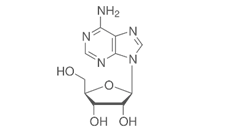 |
APPLICATIONS
It plays an important role in biochemical processes involving energy transfer and cellular signaling:
| Pharmaceutical applications: |
| Used as an antiarrhythmic drug for the rapid treatment of supraventricular tachycardia (SVT). |
| Helps restore normal heart rhythm by slowing conduction through the atrioventricular (AV) node. |
| Used in cardiac stress testing as a coronary vasodilator. |
| Biochemical and medical research |
| Serves as a key component of ATP (adenosine triphosphate), ADP, and AMP in cellular energy metabolism. |
| Used in cell signaling and receptor studies, particularly involving adenosine receptors. |
| Important in neuroprotection and inflammation research. |
| Cosmetic applications |
| Used in anti-aging skincare products to help improve skin smoothness and reduce the appearance of wrinkles. |
| Supports skin-repair and regeneration processes. |
| Nutraceutical and physiological roles |
| Studied for its role in sleep regulation, vasodilation, and immune response. |
| Acts as a neuromodulator in the central nervous system. |
SPECIFICATIONS – Ph Eur
| Test | Unit | Specification |
|---|---|---|
| Description | – | White or almost white crystalline powder. |
| Solubility | – | Slightly soluble in wáter. Soluble in hot wáter. Practically insoluble in ethanol (96%) and in methylene chloride. It dissolves (sparingly soluble) in dilute mineral acids (dilute sulphuric acid, dilute hydrochloric acid and dilute nitric acid). |
| Melting point | °C | About 234 |
| Identification by IR | – | The infrared absorption spectrum of the sample preparation should exhibit maxima only at the same wavelengths at that same wavelengths as that of a similar preparation of the Adenosine working standard. |
| Appearance of solution | – | Solution should be colourless |
| Acidity or Alkalinity | – – | a. The solution should be coloured yellow upon the addition of 0.1 ml of 0.01M hydrochloric acid b. The solution should be coloured violet blue upon the addition of 0.4 ml of 0.01M sodium hydroxide |
| Limit of chloride | ppm | NMT 100 |
| Limit of sulphates | ppm | NMT 200 |
| Limit of ammonium | ppm | NMT 10 |
| Loss on drying (for 2 hours at 105°C) | w/w | NMT 0.5 |
| Sulphated ash | w/w | NMT 0.1 |
| Assay by HPLC | % w/w | NLT 99.0 and NMT 101.0, calculated with reference to the dried substance |
| Related substance by HPLC | ||
| 1. Impurity A | % | NMT 0.2 |
| 2. Impurity G | % | NMT 0.1 |
| 3. Impurity F | % | NMT 0.1 |
| 4. Impurity H | % | NMT 0.1 |
| 5. Single largest unknown impurity | % | NMT 0.1 |
| 6. Total impurities | % | NMT 0.5 |
| 9-(2,3,5-tri-o-acetyl-β-D-Ribofuranosyl)-Adenine [condensed product] | % w/w | NMT 0.1 |
| Residual solvents | ||
| 1. Methanol | ppm | NMT 1000 |
| 2. Ethanol | ppm | NMT 2000 |
| 3. Acetonitrile | ppm | NMT 200 |
| 4. Dichloromethane | ppm | NMT 300 |
| 5. Ethyl acetate | ppm | NMT 2000 |
| Bacterial Endotoxins | EU/gm | NMT 3.0 |
| Microbial tests | ||
| – Total viable aerobic count | CFU/g | NMT 100 |
| – Total yeast and molds | CFU/g | NMT 10 |
| – Staphylococcus aureus | – | Should be absent in 1 gm |
| – Psuedomonas aeruginosa | – | Should be absent in 1 gm |
| – Escherichia coli | – | Should be absent in 1 gm |
| – Salmonella | – | Should be absent in 10 gm |
| Tin (Stannic) content | ppm | NMT 90 |
PACKING
HDPE drum.
STORAGE
Keep container at controlled room temperature up to 25°C.
CERTIFICATION
WHO-GMP, Written Confirmation (WC), DMF & CEP/COS.
ExSyn offers Adenosine on commercial scales and welcomes enquiries. Our exceptional quality and service will make ExSyn your supplier of choice! If you need any additional information or SDS, please contact us.
Guanidine carbonate is a white, crystalline, water-soluble compound with an alkaline and ionic nature. Composed of guanidinium cations and carbonate anions, it offers chemical stability, buffering capacity, and good formulation compatibility. In textile applications, it is used in formulations and fabric treatments for its thickening, softening, lubricating, anti-static, and flame-retardant properties, contributing to improved fabric finish and performance.
Tin(II) sulfide (SnS) has emerged as a safe and sustainable semiconductor owing to its non-toxicity, low cost, and natural abundance. It has attracted significant interest for solar energy conversion in thin-film photovoltaic devices because of its suitable band gap, which is approximately 1.3 eV in the orthorhombic phase and 1.5-1.7 eV in the cubic phase. In addition to photovoltaic applications, SnS is used in solid-state lubricants, near-infrared detectors, Lithium-ion batteries, and various sensing devices.
Nikethamide is a synthetic organic compound derived from nicotinic acid (vitamin B₃). It consists of a pyridine ring linked to a diethyl amide functional group and belongs to the class of pyridine amide derivatives.
(2-Methoxy-1-methyl-2-oxoethyl)triphenylphosphonium bromide is a stabilized phosphonium salt widely used as an intermediate in organic synthesis. Due to presence of an ester group, the compound generates a stabilized ylide that is particularly useful for synthesizing α, β-unsaturated esters, valuable intermediates in pharmaceuticals, agrochemicals, fragrances, and fine chemicals.
p-tert-Butylphenol (PTBP), is an aromatic organic compound consists of a phenol ring substituted with a tert-butyl group at the para (4-) position, giving it improved thermal stability and hydrophobic properties compared to phenol. PTBP features significant hydrogen bonding capabilities, which enhance its solubility in organic solvents. PTBP is used primarily as an intermediate in the manufacturing of polycarbonate plastics, phenolic resins, and epoxy resins.
Yttrium oxide (Y2O3), also known as yttria, is an air-stable, odorless white powder. It is a highly stable, chemically inert ceramic with a very high melting point. It is insoluble in water but readily dissolves in most strong acids. Increasing the specific surface area and porosity of Y2O3 can further improve its relevant physical and chemical properties.
Ethyl 7,7,7-trifluoro-3-hydroxy-3-methylheptanoate is a fluorinated aliphatic hydroxy ester. The presence of the trifluoromethyl group imparts enhanced metabolic stability, lipophilicity, and unique physicochemical properties compared with non-fluorinated analogues. This compound is primarily used as a synthetic intermediate in pharmaceutical and agrochemical research.
2-Chloro-1,1,1-trimethoxyethane is an organochlorine orthoester compound commonly used as a versatile synthetic intermediate in organic and pharmaceutical chemistry. It is a colorless to pale yellow liquid with good reactivity toward nucleophilic substitution and cyclization reactions, making it valuable in the preparation of heterocyclic and bioactive molecules.
Glycolaldehyde dimer is the cyclic dimeric form of glycolaldehyde, the simplest hydroxyaldehyde. Glycolaldehyde is often supplied as stable dimeric solid, commonly identified as 2,5-dihydroxy-1,4-dioxane.