INTRODUCTION
Indole-3-carbinol is a colorless powder with a characteristic odor.
The product finds uses in various fields by virtue of the indole ring, which is active and mainly imparts medicinal properties to the molecule. It is also an important dietary supplement.
Manufacture
Biologically, it is produced by enzyme-catalysed hydrolysis of glucosinolate, abundantly found in cabbage, cauliflower, and other vegetables of Bressica family.
Synthetically and commercially, it is product of indole-3-acetic acid reduction.
| Synonyms | Indole-3-methanol |
| CAS no. | 700-06-1 |
| EINECS no. | 211-836-2 |
| Molecular formula | C9H9NO |
| Molecular weight | 147.17 |
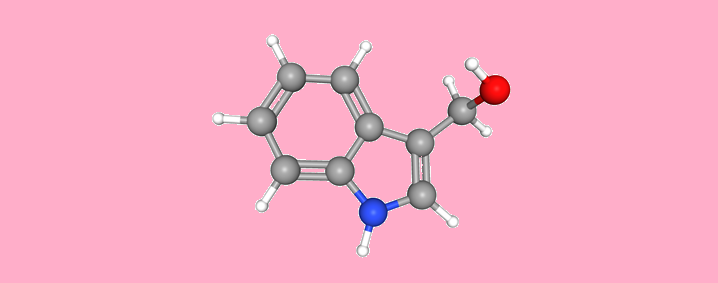
| Structure |  |
Medicinal Uses
Indiole-3-carbinol is cited to have medicinal properties and is subject of many clinical trials. It is applied in medicines to:
| prevent breast cancer |
| cure obesity |
| lower risk of prostate cancer recurrence |
Nutritional Uses
| As an antioxidant |
| Dietary supplement |
Value-added Intermediates
Indole-3-carbinol is used as a KRM to make various intermediates for pharmaceutical applications, such as:
| Indole-3-carboxylic acid |
| Indole-3-carboxaldehyde |
| Indolo[3,2b]carbazole |
| 3,3’-Diindolylmethane |
SPECIFICATIONS
| Test | Unit | Specification |
|---|---|---|
| Appearance | – | Off-white to red powder |
| Identification | – | Should give positive reaction |
| Melting range | °C | 97-100 |
| Loss on drying | % | Max 2.0 |
| Residue on ignition | % | Max 0.1 |
| Residual solvents | – | Not detected |
| Assay by HPLC | % | Min 99.0 |
| Total heavy metals | ppm | Max 10.0 |
| Lead | ppm | Max 0.5 |
| Arsenic | ppm | Max 0.5 |
| Mercury | ppm | Max 0.1 |
| Cadmium | ppm | Max 0.5 |
| Particle size | ||
| 40 mesh | % | 100 |
| 80 mesh | % | 80 |
| 120 mesh | % | 60 |
| Microbial Test | ||
| Total plate count | cfu/g | Max 1000 |
| Yeast and mold | cfu/g | Max 100 |
| Salmonella | – | Should be absent |
| E Coli | – | Should be absent |
| Staphylococcus | – | Should be absent |
| Pseudomonas | – | Should be absent |
CERTIFICATION
The product is offered from NSF-GMP facility supported by a DMF for Nutraceutical application.
STORAGE
Recommended storage temperature is 2° to 8°C
PACKING
10 kg bag in HDPE Drum
ExSyn offers indole-3-carbinol on commercial scale and welcomes enquiries. No matter the quantity you need, our exceptional quality and service will make ExSyn your supplier of choice! If you need any additional information or SDS, please get in touch with us.
N,N′-Dimethylethylenediamine (DMEDA) is an organic chemical compound belonging to the diamine family. It contains two nitrogen atoms, each bearing a methyl group, connected by a two-carbon chain.
FerroQuant™ Pro is a water-soluble chromogenic reagent widely used for the spectrophotometric determination of iron. Chemically, it is a ferroin-type ligand that forms a stable, intensely colored complex with ferrous ions (Fe²⁺).
N-Vinylformamide (NVF) is a vinyl-functionalized amide and an important monomer used in the production of poly(N-vinylformamide) (PNVF). NVF is valued for its ability to undergo polymerization, producing polymers with useful water solubility, film-forming properties, and functional groups suitable for further chemical modification.
Diacetone Alcohol (DAA) is an aliphatic hydroxy ketone produced through the base-catalysed aldol addition of two acetone molecules. It contains both ketone and tertiary hydroxyl functionalities, offering excellent solvency and chemical reactivity.
As a high-boiling oxygenated solvent and valuable chemical intermediate, DAA finds broad application in paints and coatings, printing inks, adhesives, industrial cleaning, cosmetics, and textiles. It is also used as an intermediate in the production of mesityl oxide and MIBK. (4-methylpentan-2-one).
Kojic acid is a natural fungal metabolite produced through natural fermentation of carbohydrates. It works primarily as a tyrosinase inhibitor, suppressing melanin production to help reduce dark spots and even out skin tone. It also delivers antioxidant benefits, neutralizing free radicals and protecting skin cells from oxidative stress. With its naturally weak acidic profile, kojic acid is a multifunctional ingredient suited for brightening and protective skincare formulations.
(S)-Oxetan-2-yl-methanamine is a chiral oxetane-containing primary amine. The compound features a strained four-membered oxetane ring and an aminomethyl substituent, making it a valuable building block in modern medicinal chemistry. Due to its unique physicochemical properties, including increased polarity and metabolic stability compared with conventional alkyl groups, it is widely employed as an advanced pharmaceutical intermediate in drug discovery and development programs.
Guanidine carbonate is a white, crystalline, water-soluble compound with an alkaline and ionic nature. Composed of guanidinium cations and carbonate anions, it offers chemical stability, buffering capacity, and good formulation compatibility. In textile applications, it is used in formulations and fabric treatments for its thickening, softening, lubricating, anti-static, and flame-retardant properties, contributing to improved fabric finish and performance.
Tin(II) sulfide (SnS) has emerged as a safe and sustainable semiconductor owing to its non-toxicity, low cost, and natural abundance. It has attracted significant interest for solar energy conversion in thin-film photovoltaic devices because of its suitable band gap, which is approximately 1.3 eV in the orthorhombic phase and 1.5-1.7 eV in the cubic phase. In addition to photovoltaic applications, SnS is used in solid-state lubricants, near-infrared detectors, Lithium-ion batteries, and various sensing devices.
Nikethamide is a synthetic organic compound derived from nicotinic acid (vitamin B₃). It consists of a pyridine ring linked to a diethyl amide functional group and belongs to the class of pyridine amide derivatives.