INTRODUCTION
Sodium Alginate is a linear polysaccharide derivative of alginic acid processed from brown algae. The conversion of alginic acid to sodium alginate allows its solubility in water, which assists its extraction. Sodium Alginate is used as a hydrocolloid in various applications such as food manufacturing and pharmaceuticals, as an emulsifier in textiles and cosmetics industries and in dentistry to make molds. It is widely used in Molecular Gastronomy.
| Synonyms | Alginic acid sodium salt, E 401 |
| CAS no. | 9005-38-3 |
| EINECS no. | 934-404-1 |
| Molecular formula | C6H9NaO7 |
| Molecular weight | 216.12 |
| Structure |  |
Applications
| Pharmaceuticals | Pharma grade Sodium Alginate and Alginic Acid is widely used in pharmaceutical preparations, tissue engineering, clinical treatment and cell culture. It is also used as microencapsulated material and cold resistant agent for cells. In addition, can be used as thickening agent for external ointments, oral tablets for increasing viscosity and forming gel barrier, thus prolonging the drug release time and reduce adverse reactions. It is also added in antibiotic, insulin and hormone drug solution. |
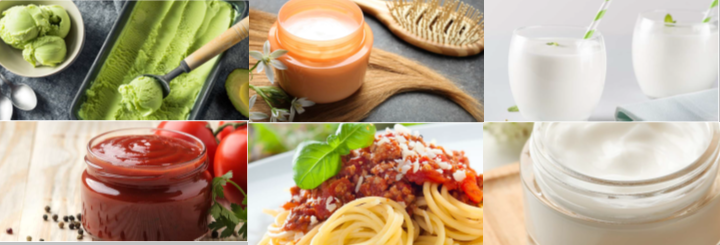
| Food Industry | Sodium Alginate is a highly viscous purified product used as a food additive, and as a thickening agent, gelling agent, emulsifier and stabilizer. It is used to enhance the texture of noodles. Also used in Vegan meat, Noodles, Ice creams, Lactic Drinks, Breads, Puddings, Yoghurts, Sauce, Cookies, Desserts, Jelly, Cheese, Spherification, etc. |
| Cosmetics | Sodium Alginate is compatible with a variety of emulsifiers and other skin ingredients. It is an excellent carrier for antioxidants and other anti-aging ingredients, and offers a heightened skin feel. It will help to soften, hydrate and soothe skin and leave it feeling silky and soft. It is used to create a skin care serum or hair gel using water, infusions, distillates and water-soluble extracts etc. |
| Impressions | Sodium Alginate can react with calcium salts forming a heat – irreversible gel. It is widely used in impression material (Dental, Hand and Leg, study models, portraits etc). Normally for impression material it is mixed with Calcium Sulfate (Gypsum), Tri Sodium Phosphate, diatomaceous earth, zinc oxide, potassium titanium fluoride etc. Alginate impression materials are easy to use, less expensive, with quick setting time. It has low water content, steady viscosity and long shelf life. Alginates fine particle size makes impression surface smooth and thus more identical to the original mould. |
SPECIFICATIONS – food grade
| Test | Unit | Specification |
|---|---|---|
| Colour | – | Cream coloured or lighter |
| Particle size | – | 80 mesh |
| Moisture | % | Less than 15 |
| pH | – | 6 – 8 |
| Ash | % | 18 – 27 |
| Viscosity (1% solution at 20° C) | mpas | 500 – 700 |
| Water insoluble matter | % | Less than 0.6 |
| Lead (as Pb) | mg/kg | Less than 5 |
| Arsenic | mg/kg | Less than 2 |
| Total plate count | cfu/gm | Less than 1000 |
| Salmonella | cfu/gm | Absent in 10 gm |
| E. Coli | cfu/gm | Absent in 1 gm |
| Yeast & Mold | cfu/gm | Less than 100 |
STORAGE
Store in a cool & dry place. Keep away from moisture.
PACKING
Standard packing is in 5 kg,10 kg, 20 kg, 25 kg corrugated cartons and 25 kg fiber board drums. Food Grade Sodium Alginate is also available in paper board containers of 100 and 500 gm for retail consumption. Impression Grade Sodium Alginate is available in 500 gm pouches.
REGISTRATION / CERTIFICATION
ISO, FSSAI, HACCP, HALAL, KOSHER & GMP certified.
No matter the quantity you need, our exceptional quality and service will make ExSyn your supplier of choice! If you need any additional information or SDS, please contact us.
Teprenone (Geranylgeranylacetone, GGA) is a mixture of the all-trans and mono-cis isomers of 6,10,14,18-tetramethyl-5,9,13,17-nonadecatetraen-2-one (in a weight ratio of 3:2). It is an acyclic isoprenoid compound with a structure like retinoids and is widely used for the treatment of gastrointestinal ulcers.
Ciclopirox Olamine (CPO) is the N-oxide of a 2 -hydroxy pyridine derivative that carries antifungal, antibacterial, and anti-inflammatory properties. It is composed of 6-cyclohexyl-1-hydroxy-4-methyl-2(1H)-pyridone combined with 2 aminoethanol (olamine) in a 1:1 ratio.
N,N-Dimethylglycine sodium salt (DMG Na) is the sodium salt form of N,N-dimethylglycine, a tertiary amino acid derivative is white to off white crystalline solid, freely soluble in water.
Blown Castor Oil (15-17 Poise) is a modified grade of Castor oil. The “15-17 Poise” specification refers to its viscosity range, indicating a medium-viscosity blown oil suitable for industrial applications requiring improved body, tackiness, and elasticity compared to regular castor oil.
Dimethylaminoethanol (DMAE) is a is a tertiary amine that is ethanolamine having two N-methyl substituents. It is clear & colourless to pale yellow liquid with ammoniacal odor. DMAE is stable at room temperature and is completely miscible with water as well as organic solvents such as alcohols and ethers. It decomposes at high temperatures. It is a versatile chemical intermediate primarily used as a curing agent for polyurethane foams and epoxy resins.
1,4,7-Trimethyl-1,4,7-triazonane (Me₃TACN) is a valuable macrocyclic tridentate ligand derived from 1,4,7-triazacyclononane. In Me₃TACN, each nitrogen atom is substituted with a methyl group, which significantly modifies its steric and electronic properties. Me₃TACN is widely used as a ligand in coordination chemistry due to its ability to form stable complexes with transition metals such as Cu, Ni, Fe, Mn, and Zn.
Adenosine is a naturally occurring purine nucleoside composed of adenine and ribose, present in all living cells. It plays a vital role in biochemical processes such as energy transfer (ATP/ADP), signal transduction, and regulation of physiological functions, and is widely used in pharmaceutical applications.
Methyl-2-Methoxy-5-Sulfamoyl Benzoate (MSMB) is a sulfur containing organic building block acting as a chemical intermediate. MSMB contains ester and sulfamoyl functional groups, which make it useful as a pharmaceutical and fine-chemical intermediate.
Imidazolidinyl urea is a widely used antimicrobial preservative in the cosmetic and personal care industry. It is a formaldehyde-releasing compound that effectively inhibits the growth of bacteria, yeast, and molds, thereby extending the shelf life of formulations. Due to its broad-spectrum efficacy and cost-effectiveness, it is commonly used in rinse-off and leave-on products within regulated concentration limits.