INTRODUCTION
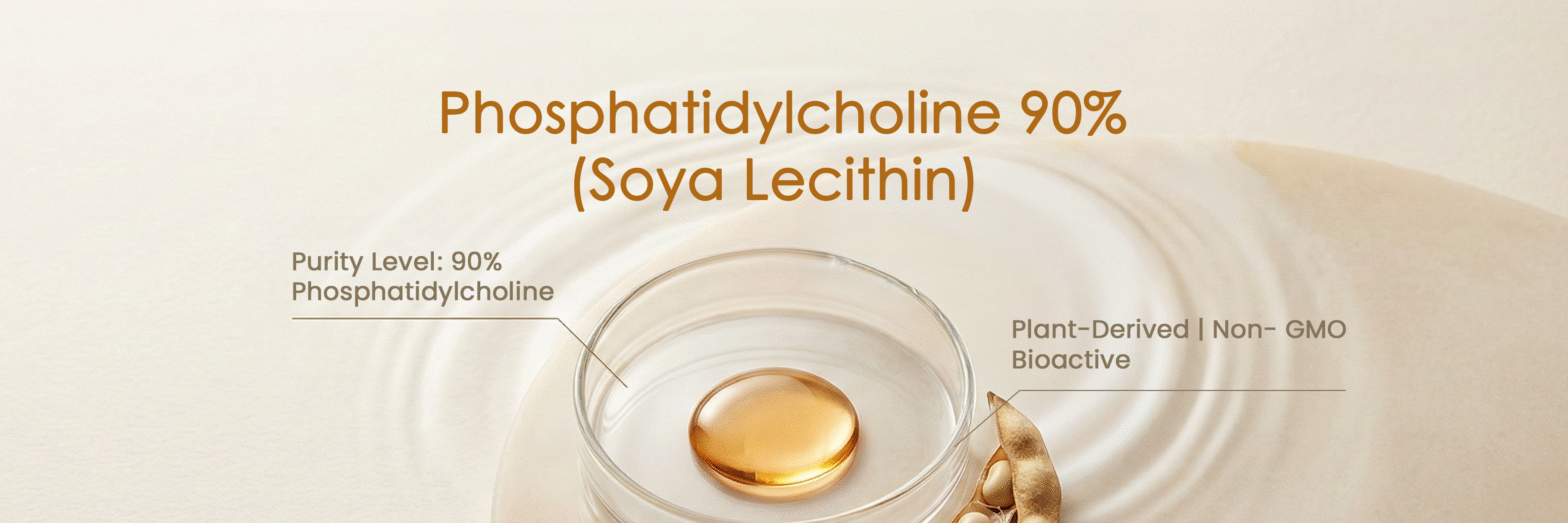
Phosphatidylcholine (PC) is one of the most important phospholipids derived from soya lecithin and represents a key structural component of cell membranes. Phosphatidylcholine 90% refers to a highly purified grade where the PC content is enriched to around 90% through specialized extraction and purification steps. It is valued for its excellent emulsifying, solubilizing, membrane-protective, and nutraceutical properties. Because it is plant-derived, non-GMO options are widely available, making it suitable for food, pharmaceutical, cosmetic, and dietary supplement applications.
MANUFACTURE
Phosphatidylcholine 90% is produced by extracting crude soya lecithin from soybean oil and subjecting it to selective solvent fractionation. The phospholipid-rich fraction is then purified through processes such as molecular distillation or chromatographic enrichment to increase PC concentration. Final polishing, drying, and deodorization yield a high-purity Phosphatidylcholine 90% suitable for nutra and pharma applications.
| Synonym | Soya phosphatidylcholines |
| CAS no. | 97281-47-5 |
| EINECS no. | 306-547-4 |
APPLICATIONS
| Nutraceuticals & Dietary Supplements |
| • Liver health formulations (supports fat metabolism and liver detox) |
| • Brain & cognitive health supplements (source of choline for neurotransmitter synthesis) |
| • Cardiovascular health due to lipid-regulating properties |
| • Liposomal drug/nutrient delivery systems |
| Pharmaceuticals |
| • Used as a primary ingredient in liposomes, niosomes, and drug delivery vesicles |
| • Emulsifier and solubilizer in injectables, topical gels, and oral suspensions |
| • Improves bioavailability of poorly soluble APIs |
| Cosmetics & Personal Care |
| • Skin-conditioning agent with membrane-repair properties |
| • Used in high-performance skincare for anti-aging, hydration, and barrier restoration |
| • Acts as a natural emulsifier and penetration enhancer |
| Food & Functional Beverages |
| • Used as a high-purity emulsifier in health beverages, infant nutrition, and fortified food products |
| • Source of choline for functional foods |
| • Helps stabilize lipid-rich formulations |
SPECIFICATIONS
| Test | Unit | Specification |
|---|---|---|
| Appearance | – | Agglomerates |
| Color | – | Yellow |
| Odour | – | Typical Predominantly Soy |
| Phosphatidyl Choline by HPLC | % | Min 90.0 |
| Lyso Phoshatidyl Choline by HPLC | % | Max 3.0 |
| Moisture | % | Max 1.5 |
| Hexane Insolubles | % | Max 0.3 |
| Toluene Insoluble | % | Max 0.3 |
| Peroxide Value | meq 02/kg | Max 5.0 |
| Acid Value | mg KOH/gm | Max 5.0 |
| Microbiological test: | ||
| Total plate count | CFU/g | Max 1000 |
| Yeast & Mould | CFU/g | Max 100 |
| Coliforms | – | Absent in 1 g |
| Enterobacteriaceae | – | Absent in 1 g |
| E. Coli | – | Absent in 1 g |
| Salmonella | – | Absent in 375 g |
| Heavy Metals: | ||
| Lead | ppm | Max 2 |
| Cadmium | ppm | Max 1 |
| Arsenic | ppm | Max 1 |
| Mercury | ppm | Max 0.1 |
PACKING
1 kg to 5 kg aluminum bags in insulated box
STORAGE
Store in a cool, dry place at temperatures below 0°C. Reclose packaging immediately after opening.
CERTIFICATION
Non-GMO, Kosher, Halal.
REACH status
Not registered.
ExSyn offers Soya Phosphatidylcholine on commercial scales and welcomes enquiries. Our exceptional quality and service will make ExSyn your supplier of choice! If you need any additional information or SDS, please contact us.
TensyraTM N-10 (Octoxinol 10; tert-octyl phenyl ethoxylate) is a non-ionic surfactant known for its excellent solubilizing and membrane-permeabilizing properties. It features a hydrophilic polyethylene oxide chain paired with a lipophilic aromatic hydrocarbon group.It readily breaks down biological membranes to lyse cells, solubilize proteins, and permeabilize cell membranes for assays.
Teprenone (Geranylgeranylacetone, GGA) is a mixture of the all-trans and mono-cis isomers of 6,10,14,18-tetramethyl-5,9,13,17-nonadecatetraen-2-one (in a weight ratio of 3:2). It is an acyclic isoprenoid compound with a structure like retinoids and is widely used for the treatment of gastrointestinal ulcers.
Ciclopirox Olamine (CPO) is the N-oxide of a 2 -hydroxy pyridine derivative that carries antifungal, antibacterial, and anti-inflammatory properties. It is composed of 6-cyclohexyl-1-hydroxy-4-methyl-2(1H)-pyridone combined with 2 aminoethanol (olamine) in a 1:1 ratio.
N,N-Dimethylglycine sodium salt (DMG Na) is the sodium salt form of N,N-dimethylglycine, a tertiary amino acid derivative is white to off white crystalline solid, freely soluble in water.
Blown Castor Oil (15-17 Poise) is a modified grade of Castor oil. The “15-17 Poise” specification refers to its viscosity range, indicating a medium-viscosity blown oil suitable for industrial applications requiring improved body, tackiness, and elasticity compared to regular castor oil.
Dimethylaminoethanol (DMAE) is a is a tertiary amine that is ethanolamine having two N-methyl substituents. It is clear & colourless to pale yellow liquid with ammoniacal odor. DMAE is stable at room temperature and is completely miscible with water as well as organic solvents such as alcohols and ethers. It decomposes at high temperatures. It is a versatile chemical intermediate primarily used as a curing agent for polyurethane foams and epoxy resins.
1,4,7-Trimethyl-1,4,7-triazonane (Me₃TACN) is a valuable macrocyclic tridentate ligand derived from 1,4,7-triazacyclononane. In Me₃TACN, each nitrogen atom is substituted with a methyl group, which significantly modifies its steric and electronic properties. Me₃TACN is widely used as a ligand in coordination chemistry due to its ability to form stable complexes with transition metals such as Cu, Ni, Fe, Mn, and Zn.
Adenosine is a naturally occurring purine nucleoside composed of adenine and ribose, present in all living cells. It plays a vital role in biochemical processes such as energy transfer (ATP/ADP), signal transduction, and regulation of physiological functions, and is widely used in pharmaceutical applications.
Methyl-2-Methoxy-5-Sulfamoyl Benzoate (MSMB) is a sulfur containing organic building block acting as a chemical intermediate. MSMB contains ester and sulfamoyl functional groups, which make it useful as a pharmaceutical and fine-chemical intermediate.