INTRODUCTION
N,N-Dimethylglycine sodium salt (DMG Na) is the sodium salt form of N,N-dimethylglycine, a tertiary amino acid derivative is white to off white crystalline solid, freely soluble in water. It is commonly used in pharmaceutical, nutraceutical, and biochemical applications.
MANUFACTURE
DMG Na is produced industrially over two steps from glycine. First step involves Eschweiler–Clarke methylation of glycine using formaldehyde and formic acid under controlled condition to get N,N-dimethylglycine (free base). The second step is formation of sodium salt using sodium hydroxide in aqueous media under controlled conditions.
| Synonyms | Glycine, N,N-dimethyl-, sodium salt (1:1), Taminizer D |
| CAS no. | 18319-88-5 |
| EINECS no. | 242-206-5 |
| Molecular formula | C4H8NNaO2 |
| Molecular weight | 125.10 |
| Structure | 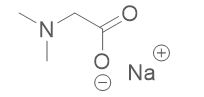 |
APPLICATIONS
DMG Na has several industrial, pharmaceutical, and nutritional applications due to its role as a methylated amino acid derivative and a metabolic intermediate.
| Pharmaceutical Industry |
| Applied in drug development and biochemical formulations where methylated amino acid derivatives are required. |
| Nutraceuticals & Dietary Supplements |
| Used in dietary supplements that support: |
| Energy metabolism |
| Immune system function |
| Oxygen utilization in the body |
| Often included in sports nutrition products and metabolic support formulations. |
| Animal Nutrition |
| Added to animal feed supplements to support: |
| Growth and metabolism |
| Stress tolerance |
| Performance in poultry, livestock, and pets. |
| Biochemical & Laboratory Research |
| Used in metabolic and methylation pathway studies. |
| Acts as a methyl group donor compound in biochemical research. |
| Chemical Synthesis |
| Serves as a building block in organic synthesis for producing: |
| Specialty chemicals |
| Amino acid derivatives |
| Functional biochemical compounds. |
SPECIFICATIONS
| Test | Unit | Specification |
|---|---|---|
| Appearance | – | White crystalline powder |
| Purity | % Area | NLT 98 |
| pH | – | 10.0-12.0 |
| Chloride | % | NMT 0.04 |
| Loss on drying | % | NMT 5.0 |
| Heavy metals | ||
| Lead (Pb) | ppm | NMT 3.0 |
| Arsenic (As) | ppm | NMT 2.0 |
| Cadmium (Cd) | ppm | NMT 1.0 |
| Mercury (Hg) | ppm | NMT 0.1 |
| Microbiological | ||
| Total Plate Count | cfu/g | NMT 1000 |
| Yeast & Mold | cfu/g | NMT 100 |
| E.Coli | Absent | |
| Salmonella | Absent |
STORAGE & PRECAUTION
Store in a well-closed container away from moisture, direct light and heat.
PACKING
25 kg fiber drums
REACH Status
Not registered
ExSyn offers DMG Na on commercial scales and welcomes enquiries. No matter the quantity you need, our exceptional quality and service will make ExSyn your supplier of choice! If you need any additional information or SDS, please contact us.
Teprenone (Geranylgeranylacetone, GGA) is a mixture of the all-trans and mono-cis isomers of 6,10,14,18-tetramethyl-5,9,13,17-nonadecatetraen-2-one (in a weight ratio of 3:2). It is an acyclic isoprenoid compound with a structure like retinoids and is widely used for the treatment of gastrointestinal ulcers.
Ciclopirox Olamine (CPO) is the N-oxide of a 2 -hydroxy pyridine derivative that carries antifungal, antibacterial, and anti-inflammatory properties. It is composed of 6-cyclohexyl-1-hydroxy-4-methyl-2(1H)-pyridone combined with 2 aminoethanol (olamine) in a 1:1 ratio.
Blown Castor Oil (15-17 Poise) is a modified grade of Castor oil. The “15-17 Poise” specification refers to its viscosity range, indicating a medium-viscosity blown oil suitable for industrial applications requiring improved body, tackiness, and elasticity compared to regular castor oil.
Dimethylaminoethanol (DMAE) is a is a tertiary amine that is ethanolamine having two N-methyl substituents. It is clear & colourless to pale yellow liquid with ammoniacal odor. DMAE is stable at room temperature and is completely miscible with water as well as organic solvents such as alcohols and ethers. It decomposes at high temperatures. It is a versatile chemical intermediate primarily used as a curing agent for polyurethane foams and epoxy resins.
1,4,7-Trimethyl-1,4,7-triazonane (Me₃TACN) is a valuable macrocyclic tridentate ligand derived from 1,4,7-triazacyclononane. In Me₃TACN, each nitrogen atom is substituted with a methyl group, which significantly modifies its steric and electronic properties. Me₃TACN is widely used as a ligand in coordination chemistry due to its ability to form stable complexes with transition metals such as Cu, Ni, Fe, Mn, and Zn.
Adenosine is a naturally occurring purine nucleoside composed of adenine and ribose, present in all living cells. It plays a vital role in biochemical processes such as energy transfer (ATP/ADP), signal transduction, and regulation of physiological functions, and is widely used in pharmaceutical applications.
Methyl-2-Methoxy-5-Sulfamoyl Benzoate (MSMB) is a sulfur containing organic building block acting as a chemical intermediate. MSMB contains ester and sulfamoyl functional groups, which make it useful as a pharmaceutical and fine-chemical intermediate.
Imidazolidinyl urea is a widely used antimicrobial preservative in the cosmetic and personal care industry. It is a formaldehyde-releasing compound that effectively inhibits the growth of bacteria, yeast, and molds, thereby extending the shelf life of formulations. Due to its broad-spectrum efficacy and cost-effectiveness, it is commonly used in rinse-off and leave-on products within regulated concentration limits.
Phosphorodiamidites are a unique class of phosphorus-based compounds characterized by one P–O bond and two P–N moieties. 2-Cyanoethyl tetraisopropylphosphorodiamidite plays a crucial role in solid-phase oligonucleotide synthesis. Beyond their application as synthetic precursors for oligonucleotides, phosphorodiamidites have also been reported as valuable starting materials for the synthesis of industrially relevant polymers and flame-resistant materials, including adhesives, coatings, and laminates.