INTRODUCTION
Niacinamide is a naturally occurring nutrient belonging to the pyridine carboxylic acid family. It is an important form of vitamin B3, an essential nutrient that supports many cellular processes and plays an important role in energy metabolism. Animal and refined grain-based products are fortified with Niacinamide.
It is a water-soluble vitamin that promotes release of energy from foods and enhances proper nervous system functioning. Along with systemic benefits, it also offers a wide range of topical benefits. Also, it is the preferred form of Vitamin B3 for treating Pellagra.
| Synonym | Nicotinic acid amide, Pyridine-3-carboxylic acid amide, Vitamin B3, Vitamin PP, 3- Pyridinecarboxamide, Beta Pyridinecarboxamide |
| CAS no. | 98-92-0 |
| EINECS no. | 202-713-4 |
| Chemical Formula | C6H6N2O |
SPECIFICATIONS | Niacinamide Ph.Eur
| Test | Unit | Specification |
|---|---|---|
| Appearance | – | White or almost white crystalline powder or colorless crystals |
| pH | – | 6.0 – 7.5 |
| Assay on dried substance (Chemical – Titrimetic) | – | 99.0 – 101.0 |
| Loss on Drying | % w/w | Max 0.5 |
| Unspecified impurity | % | Max 0.10 |
| Total Impurities | % | Max 0.2 |
| Sulfated Ash | %w/w | Max 0.1 |
APPICATIONS
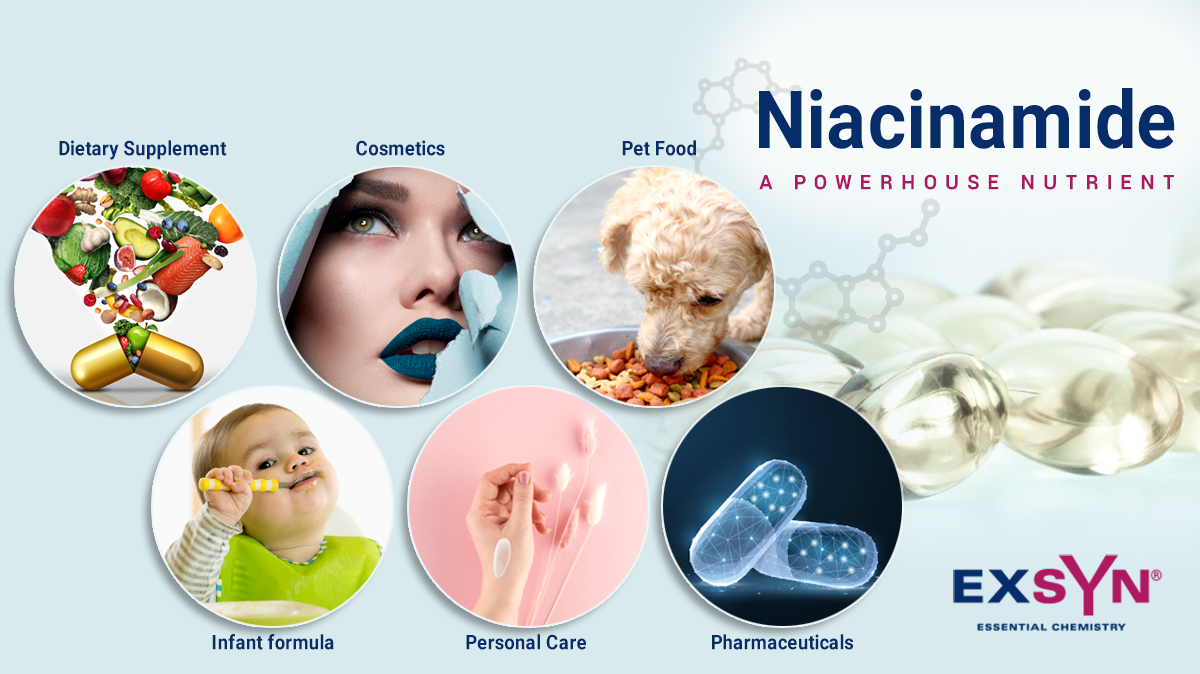
Common applications for niacinamide are in food, feed and beverages, health and personal care and the pharmaceutical industry. Niacinamide has several other health benefits and uses as follows:
HELPFUL FOR SKIN CARE & IN PREVENTING SKIN CANCER
Niacinamide plays an important role in keeping the skin healthy. For this reason, it’s a popular additive in the cosmetic and skincare industry. When applied topically or taken orally as a supplement, niacinamide has been shown to have anti-inflammatory effects on the skin. It has been used to treat skin conditions like acne and rosacea, a facial skin disorder characterized by redness.
t is also a promising supplement which may help in preventing Melanoma which is a serious type of skin cancer that develops in the cells that produce melanin, the pigment that gives your skin its color. Owing to its role in keeping your cells healthy, oral supplements of niacinamide have been shown to enhance DNA repair in UV damaged skin in humans.
THERAPEUTIC BENEFITS / USES
Chronic kidney disease is the progressive loss of kidney function which can cause a harmful buildup of chemicals.
Research suggests that niacinamide may help decrease phosphate levels in people with kidney dysfunction by blocking its absorption. It’s been suggested that niacinamide protects and preserves the beta cells, thereby preventing or delaying the onset of type 1 diabetes in at-risk individuals.
| INDUSTRY | APPLICATIONS |
|---|---|
| Food & Beverage | Nutrient supplement in foods such as dairy, breakfast cereals & infant formulas, as an additive in beverages, energy/health drinks |
| Health & Personal Care | Used in formulations of foundations, moisturizers, skin care products, lipsticks and eye shadows |
| Pharmaceuticals | Predominantly used as a dietary supplement & vitamin supplement in health drinks and also used in antipellagra factor drug |
| Animal Feed | Nutritional supplement in animal feed as well as pet food |
REGISTRATIONS / CERTIFICATIONS
| WHO-GMP |
| FAMI-QS |
| HACCP |
| Kosher |
| Halal |
PACKAGING OPTIONS
| Bulk Bags |
| HDPE/Fibre Drums |
STORAGE
Store in a sheltered place away from sources of heat and moisture.
Niacinamide is offered by ExSyn and is available for prompt delivery. No matter the quantity you need, our exceptional quality and service will make ExSyn your supplier of choice! If you need any additional information or SDS, please get in touch with us.
TensyraTM N-10 (Octoxinol 10; tert-octyl phenyl ethoxylate) is a non-ionic surfactant known for its excellent solubilizing and membrane-permeabilizing properties. It features a hydrophilic polyethylene oxide chain paired with a lipophilic aromatic hydrocarbon group.It readily breaks down biological membranes to lyse cells, solubilize proteins, and permeabilize cell membranes for assays.
Teprenone (Geranylgeranylacetone, GGA) is a mixture of the all-trans and mono-cis isomers of 6,10,14,18-tetramethyl-5,9,13,17-nonadecatetraen-2-one (in a weight ratio of 3:2). It is an acyclic isoprenoid compound with a structure like retinoids and is widely used for the treatment of gastrointestinal ulcers.
Ciclopirox Olamine (CPO) is the N-oxide of a 2 -hydroxy pyridine derivative that carries antifungal, antibacterial, and anti-inflammatory properties. It is composed of 6-cyclohexyl-1-hydroxy-4-methyl-2(1H)-pyridone combined with 2 aminoethanol (olamine) in a 1:1 ratio.
N,N-Dimethylglycine sodium salt (DMG Na) is the sodium salt form of N,N-dimethylglycine, a tertiary amino acid derivative is white to off white crystalline solid, freely soluble in water.
Blown Castor Oil (15-17 Poise) is a modified grade of Castor oil. The “15-17 Poise” specification refers to its viscosity range, indicating a medium-viscosity blown oil suitable for industrial applications requiring improved body, tackiness, and elasticity compared to regular castor oil.
Dimethylaminoethanol (DMAE) is a is a tertiary amine that is ethanolamine having two N-methyl substituents. It is clear & colourless to pale yellow liquid with ammoniacal odor. DMAE is stable at room temperature and is completely miscible with water as well as organic solvents such as alcohols and ethers. It decomposes at high temperatures. It is a versatile chemical intermediate primarily used as a curing agent for polyurethane foams and epoxy resins.
1,4,7-Trimethyl-1,4,7-triazonane (Me₃TACN) is a valuable macrocyclic tridentate ligand derived from 1,4,7-triazacyclononane. In Me₃TACN, each nitrogen atom is substituted with a methyl group, which significantly modifies its steric and electronic properties. Me₃TACN is widely used as a ligand in coordination chemistry due to its ability to form stable complexes with transition metals such as Cu, Ni, Fe, Mn, and Zn.
Adenosine is a naturally occurring purine nucleoside composed of adenine and ribose, present in all living cells. It plays a vital role in biochemical processes such as energy transfer (ATP/ADP), signal transduction, and regulation of physiological functions, and is widely used in pharmaceutical applications.
Methyl-2-Methoxy-5-Sulfamoyl Benzoate (MSMB) is a sulfur containing organic building block acting as a chemical intermediate. MSMB contains ester and sulfamoyl functional groups, which make it useful as a pharmaceutical and fine-chemical intermediate.