INTRODUCTION
Methylene blue (MB), a basic thiazine dye has been used clinically for about a century to treat numerous ailments. Primarily used in the treatment of methemoglobinemia, as an antidote in cyanide poisoning, as a biological stain, and as an oxidant-reduction indicator.
The intravenous form of MB is approved by the FDA for the treatment of pediatric and adult patients with acquired methemoglobinemia. MB is an investigational drug being developed by the University of Aberdeen and TauRx Therapeutics that has been shown in early clinical trials to be an inhibitor of Tau protein aggregation. The drug is also of potential interest for the treatment of patients with Alzheimer’s disease.
| Synonyms | Methylthioninium chloride Basic blue 9 (C.I. 52015) |
| CAS no. | 122965-43-9 (hydrate) 7220-79-3 (trihydrate) 61-73-4 (anhydrous) |
| EINECS no. | 602-909-3 (hydrate) 615-731-6 (trihydrate) 200-515-2 (anhydrous) |
| Molecular formula | C16H18N3S.Cl.xH2O |
| Molecular weight | 337.90 (hydrate & trihydrate) 319.85 (anhydrous) |
| Structure | 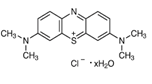 |
MEDICAL APPLICATIONS
| Methemoglobinemia | MB is employed as a medication for the treatment of methemoglobinemia |
| Combined with light | MB combined with light has been used to treat resistant plaque psoriasis |
| Urinary tract infection | MB is a component of a urinary analgesic/anti-infective/anti-spasmodic known as “Prosed DS”, a combination of phenyl salicylate, benzoic acid, hyoscyamine sulfate, and methenamine (aka hexamethylenetetramine and not to be confused with ‘methanamine’) |
| Cyanide poisoning | Since its reduction potential is similar to that of oxygen and can be reduced by components of the electron transport chain, large doses of methylene blue are sometimes used as an antidote to potassium cyanide poisoning |
| Dye or stain | MB is used in endoscopic polypectomy as an adjunct to saline or epinephrine and is used for injection into the submucosa around the polyp to be removed |
| Placebo | MB has been used as a placebo; physicians would tell their patients to expect their urine to change color and view this as a sign that their condition had improved |
| Ifosfamide toxicity | Another use of methylene blue is to treat Ifosfamide neurotoxicity |
| Shock | It has also been used in septic shock and anaphylaxis |
OTHER APPLICATIONS
| Redox indicator | MB is widely used as a redox indicator in analytical chemistry |
| Peroxide generator | MB is also a photosensitizer used to create singlet oxygen when exposed to both oxygen and light |
| Biological staining | In biology MB is used as a dye for number of different staining procedures, such as Wright’s stain and Jenner’s stain. Since it is a temporary staining technique, MB can also be used to examine RNA or DNA under the microscope or in a gel |
| Aquaculture | MB is used in aquaculture and by tropical fish hobbyists as a treatment for fungal infections |
Modes of action of Methylene Blue in SARS-CoV-2 infection complications (as per the current ongoing studies. Concrete data to be available soon)
| It inhibits SARS-CoV-2 spike ACE2 protein – protein interaction |
| To treat Cytokinin Storm which is one of the major reason for ADRs, Multiorgan Failure & Mortality |
| It relieves oxidative stress, ROS and free radicals |
| It increases systemic vascular resistance (SVR) in septic shock |
| It causes antifibrotic action in lungs |
SPECIFICATIONS
MB offered by Exsyn complies USP & EP pharmacopeia. Please ask our sourcing team if you need detailed specifications.
WRITTEN CONFIRMATION (WC)
ExSyn offers MB with WC certification, so it can be sold to the EU as an API for human consumption.
STORAGE
Temporary storage temperature is below 30°C
Long term storage temperature is 5°C ± 3°C
ExSyn offers MB on commercial scale and welcomes enquiries. No matter the quantity you need, our exceptional quality and service will make ExSyn your supplier of choice! If you need any additional information or SDS, please get in touch with us.
Teprenone (Geranylgeranylacetone, GGA) is a mixture of the all-trans and mono-cis isomers of 6,10,14,18-tetramethyl-5,9,13,17-nonadecatetraen-2-one (in a weight ratio of 3:2). It is an acyclic isoprenoid compound with a structure like retinoids and is widely used for the treatment of gastrointestinal ulcers.
Ciclopirox Olamine (CPO) is the N-oxide of a 2 -hydroxy pyridine derivative that carries antifungal, antibacterial, and anti-inflammatory properties. It is composed of 6-cyclohexyl-1-hydroxy-4-methyl-2(1H)-pyridone combined with 2 aminoethanol (olamine) in a 1:1 ratio.
N,N-Dimethylglycine sodium salt (DMG Na) is the sodium salt form of N,N-dimethylglycine, a tertiary amino acid derivative is white to off white crystalline solid, freely soluble in water.
Blown Castor Oil (15-17 Poise) is a modified grade of Castor oil. The “15-17 Poise” specification refers to its viscosity range, indicating a medium-viscosity blown oil suitable for industrial applications requiring improved body, tackiness, and elasticity compared to regular castor oil.
Dimethylaminoethanol (DMAE) is a is a tertiary amine that is ethanolamine having two N-methyl substituents. It is clear & colourless to pale yellow liquid with ammoniacal odor. DMAE is stable at room temperature and is completely miscible with water as well as organic solvents such as alcohols and ethers. It decomposes at high temperatures. It is a versatile chemical intermediate primarily used as a curing agent for polyurethane foams and epoxy resins.
1,4,7-Trimethyl-1,4,7-triazonane (Me₃TACN) is a valuable macrocyclic tridentate ligand derived from 1,4,7-triazacyclononane. In Me₃TACN, each nitrogen atom is substituted with a methyl group, which significantly modifies its steric and electronic properties. Me₃TACN is widely used as a ligand in coordination chemistry due to its ability to form stable complexes with transition metals such as Cu, Ni, Fe, Mn, and Zn.
Adenosine is a naturally occurring purine nucleoside composed of adenine and ribose, present in all living cells. It plays a vital role in biochemical processes such as energy transfer (ATP/ADP), signal transduction, and regulation of physiological functions, and is widely used in pharmaceutical applications.
Methyl-2-Methoxy-5-Sulfamoyl Benzoate (MSMB) is a sulfur containing organic building block acting as a chemical intermediate. MSMB contains ester and sulfamoyl functional groups, which make it useful as a pharmaceutical and fine-chemical intermediate.
Imidazolidinyl urea is a widely used antimicrobial preservative in the cosmetic and personal care industry. It is a formaldehyde-releasing compound that effectively inhibits the growth of bacteria, yeast, and molds, thereby extending the shelf life of formulations. Due to its broad-spectrum efficacy and cost-effectiveness, it is commonly used in rinse-off and leave-on products within regulated concentration limits.