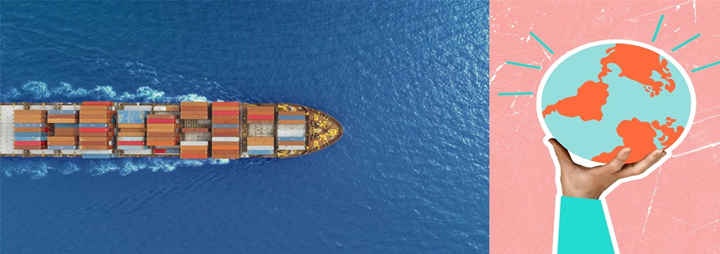
Chinese New Year 2024 is upon us, disrupting logistics from Asia starting Feb 10th. This event is expected to impact global shipping until Feb 21. Freight rates from Asia has skyrocketed with rates to the US surging by 3.5X and Europe by 6X. This increase is largely due to the Red Sea crisis, further compounded by the Panama Canal’s capacity limitation. Businesses are advised to proactively share forecasts with freight forwarders in order to plan and procure space accordingly.
The state of the freight market is harder to determine as market conditions play a major role in determining freight prices. In this context, the Red Sea crisis is unmistakably prominent, as container lines have levied war-risk surcharges, introduced higher GRIs, and even pushed for peak-season surcharges to compensate for going around the Horn of Africa instead of the Suez Canal.
Freight rates between China and N.Europe exploded since the crisis, rising from around $1,200 per TEU in the first week of Dec ‘23 to over $5,200 per TEU in the last week of Jan ‘24 — a near five-fold increase. Freight rates have gone up across other major lanes as well, with the trans-Pacific China-US West Coast rising from roughly $1,600 per TEU in late Dec ‘23 to over $4,000 per TEU in the last week of Jan ‘24.
However, the prices seem to be stabilizing, as reflected in the Shanghai Containerized Freight Index (SCFI) from Jan 26. The rate increase seems to have peaked as the next few weeks during the CNY will be mellow. With consumer demand in a trough, and container capacity remaining high, there would be little incentive for shippers to frantically buy freight space, which would result in freight rates again ticking lower post-CNY.
The situation is further complicated for businesses shipping between China and the US East Coast or Gulf Coast, thanks to the droughts seen at the Panama Canal over the last year — a consequence of the El Niño climatic pattern. This reduced the number of vessels that could pass through daily, with the canal operating at 70% capacity today. The volume of loads allowed on every vessel have reduced as well, as lower water levels in the canal locks decrease the maximum depth of vessels.
The UN’s trade and development body, UNCTAD, has raised profound concerns over escalating disruptions to global trade.
It says that recent attacks on ships in the Red Sea, combined with geopolitical tensions affecting shipping in the Black Sea and the impacts of climate change on the Panama Canal, have given rise to a complex crisis affecting key trade routes.
Reference:
Today we announce that Exim is rebranding as ExSyn. We are presenting a new brand identity and website as a reflection of our relentless transformation over the course of 30 years serving the pharma and chemical industries. The new brand builds upon our core strengths as a sourcing company and captures our most essential duty: helping improve people’s health and lives.
TensyraTM N-10 (Octoxinol 10; tert-octyl phenyl ethoxylate) is a non-ionic surfactant known for its excellent solubilizing and membrane-permeabilizing properties. It features a hydrophilic polyethylene oxide chain paired with a lipophilic aromatic hydrocarbon group.It readily breaks down biological membranes to lyse cells, solubilize proteins, and permeabilize cell membranes for assays.
Teprenone (Geranylgeranylacetone, GGA) is a mixture of the all-trans and mono-cis isomers of 6,10,14,18-tetramethyl-5,9,13,17-nonadecatetraen-2-one (in a weight ratio of 3:2). It is an acyclic isoprenoid compound with a structure like retinoids and is widely used for the treatment of gastrointestinal ulcers.
Ciclopirox Olamine (CPO) is the N-oxide of a 2 -hydroxy pyridine derivative that carries antifungal, antibacterial, and anti-inflammatory properties. It is composed of 6-cyclohexyl-1-hydroxy-4-methyl-2(1H)-pyridone combined with 2 aminoethanol (olamine) in a 1:1 ratio.