
INTRODUCTION
Oleic acid is an organic liquid that belongs to class of organic fatty acids. It is a monosaturated omega-9 fatty acid that occurs naturally as triglyceride in vegetable oils and fats, tallow oil, olive oil, and membrane phospholipids.
Manufacture
On industrial scale, it is manufactured by dehydrogenation of stearic acid.
| Synonym | cis-9-Octanedioic acid Elainic acid (Z)-octadec-9-enoic acid |
| CAS no. | 112-80-1 |
| EINECS no. | 204-007-1 |
| Molecular formula | C18H34O2 |
| Molecular weight | 282.46 |
| Structure | 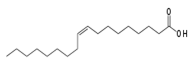 |
Applications
| Intermediates |
|---|
| Azelaic acid |
| Oleyl alcohol |
| Oleic acid methyl ester |
| Oleamide |
| PEG monooleate |
| Pentaerythrityl oleate |
| Triolein |
| Oleyloxazoline |
| Others |
|---|
| as emulsifier for facial creams and lotions |
| as emulsifier in food, beverages, and leather industries |
| as accelerator in rubber |
| as drilling and fracking agent in oil & gas |
| as stabilizer and emulsifier in textiles |
| as anionic surfactant in soaps and detergents |
SPECIFICATIONS
| Test | Unit | Specifications |
|---|---|---|
| Appearance | – | Clear colourless to light yellow liquid |
| Acid value | mg KOH/gm | 190.0 – 203.0 |
| Peroxide | meq/kg | Max 10 |
| Moisture | % | Max 0.2 |
| Impurities by GC (methyl ester derivatives) | ||
| Elaidic acid | % | Max 0.3 |
| Palmitic acid | % | Max 0.5 |
| Linoleic acid | % | Max 0.5 |
| Other impurities | % | Max 1.0 |
| Purity by GC (methyl ester derivative) | % | Min 99.0 |
STORAGE
Stored at ambient temperature
PACKING
160 kg Composite drum
REACH Status
Not registered
ExSyn offers oleic acid on commercial scales and welcomes enquiries. No matter the quantity you need, our exceptional quality and service will make ExSyn your supplier of choice! If you need any additional information or SDS, please contact us.
Indorez® Kota Resin is a modified non self-cured phenolic resin, it can increase rubber adhesion to steel, polyester, rayon, nylon, aramid and other fabric cord. It’s an adhesive agent, acts as methylene acceptor, can 100% replace resorcinol and resorcinol resins in resorcinol- formaldehyde-silica, enhance adhesion between rubber and reinforcing materials.
Glyceryl Stearate Citrate (GSC) is a plant-derived, biodegradable emulsifier commonly used in cosmetics and personal-care products. It functions primarily as an anionic oil-in-water (O/W) emulsifier, helping blend oils and water into smooth, stable creams and lotions. Its natural origin and gentle profile make it popular in eco-certified, organic, and sensitive-skin formulations.
DL-Serine is a racemic mixture of both the D- and L-forms of the amino acid serine, which is a polar, nonessential amino acid. It is an α-amino acid characterized by its hydroxyl-containing side chain, which enables it to take part in numerous biochemical reactions and synthetic processes. It functions as a pivotal intermediate in the biosynthesis of amino acids, including glycine and cysteine, underscoring its essential role in cellular metabolism. Moreover, it constitutes a critical pharmaceutical intermediate for the synthesis of a broad spectrum of therapeutic agents and drug candidates.
Ethyl vinyl ether is a reactive, flammable, volatile liquid with a strong ether-like odor. Featuring two conjugated functional groups—an ether and an alkene—this molecule act as important building block, especially in polymer synthesis. Its applications span multiple industrial sectors, including semiconductors, coatings, inks, fragrances, adhesives, paints, oil viscosity modifiers and pharmaceuticals, with promising potential as a dietary supplement.
Peppermint (Mentha piperita) is a common herb, also known as a hybrid mint. Its main components are oxygenated monoterpenes: alcohols, esters and ketones. Peppermint oleoresin microencapsulated powder is a white to off-white coloured powder produced from the seeds of the plant. In order to protect and maintain the stability of peppermint oil, microencapsulation is carried out through process optimization using the coacervation technique. This technique helps limit the loss and degradation of flavours and aromas during processing and storage. It offers versatile applications across multiple industries — from food and beverages to pharmaceuticals, cosmetics, and textiles.
5-Methyl-3-vinyl-2-oxazolidinone (V-MOX) is a highly reactive monomer valued for its low viscosity, mild odor, and excellent reactivity. It is widely used as a reactive diluent in UV-curable inks and coatings, where it enhances adhesion, produces brighter colors, and improves safety compared to conventional diluents. In addition, V-MOX serves as a key building block in the synthesis of kinetic hydrate inhibitor (KHI) polymers, which are applied in oil and gas production to prevent hydrate blockages in pipelines.
Zinc ricinoleate is the zinc salt of ricinoleic acid, a hydroxylated fatty acid derived mainly from castor oil (Ricinus communis). It appears as a white to slightly yellowish powder, waxy solid, or paste, depending on formulation. Its most valuable property is its ability to trap and absorb odor molecules such as amines, sulfides, and short-chain fatty acids, making it an essential ingredient in deodorant and odor-control products.
2-(tert-Butyl amino)ethyl methacrylate (TBAEMA) is a functional methacrylate monomer that contains a secondary amine group and a hydrophobic tert-butyl moiety, giving it excellent versatility in pH-responsive and adhesion-enhancing polymer systems.
It is valued in printing ink formulations for its ability to enhance adhesion, flexibility, and surface interaction.
Commonly known as potassium bis(fluorosulfonyl)imide (KFSI), the compound has a three-carbon backbone bearing six fluorine atoms and two sulfonimide (-SO₂F) groups. The molecule’s architecture lends it both high chemical stability and useful reactivity. Because of its excellent ionic conductivity and thermal / electrochemical stability, it finds use in advanced electrolyte formulations—for example in lithium-ion and next-generation batteries, in ionic liquids, and in other electrochemical systems.